Disclaimer: Syntium Algo and all affiliated parties are not registered as financial advisors. The information provided on this site, along with the products and services offered by Syntium Algo, are intended for educational purposes only and should not be interpreted as financial advice. It is important to understand the risks involved in trading and be willing to accept any level of risk when investing in financial markets. Please note that past performance is not necessarily indicative of future results. Syntium Algo and all individuals associated with the company has no responsibility for your trading results or invest decisions. It is recommended to conduct through research, seek professional advice, and carefully consider your financial situation before making any trading or investment decisions.
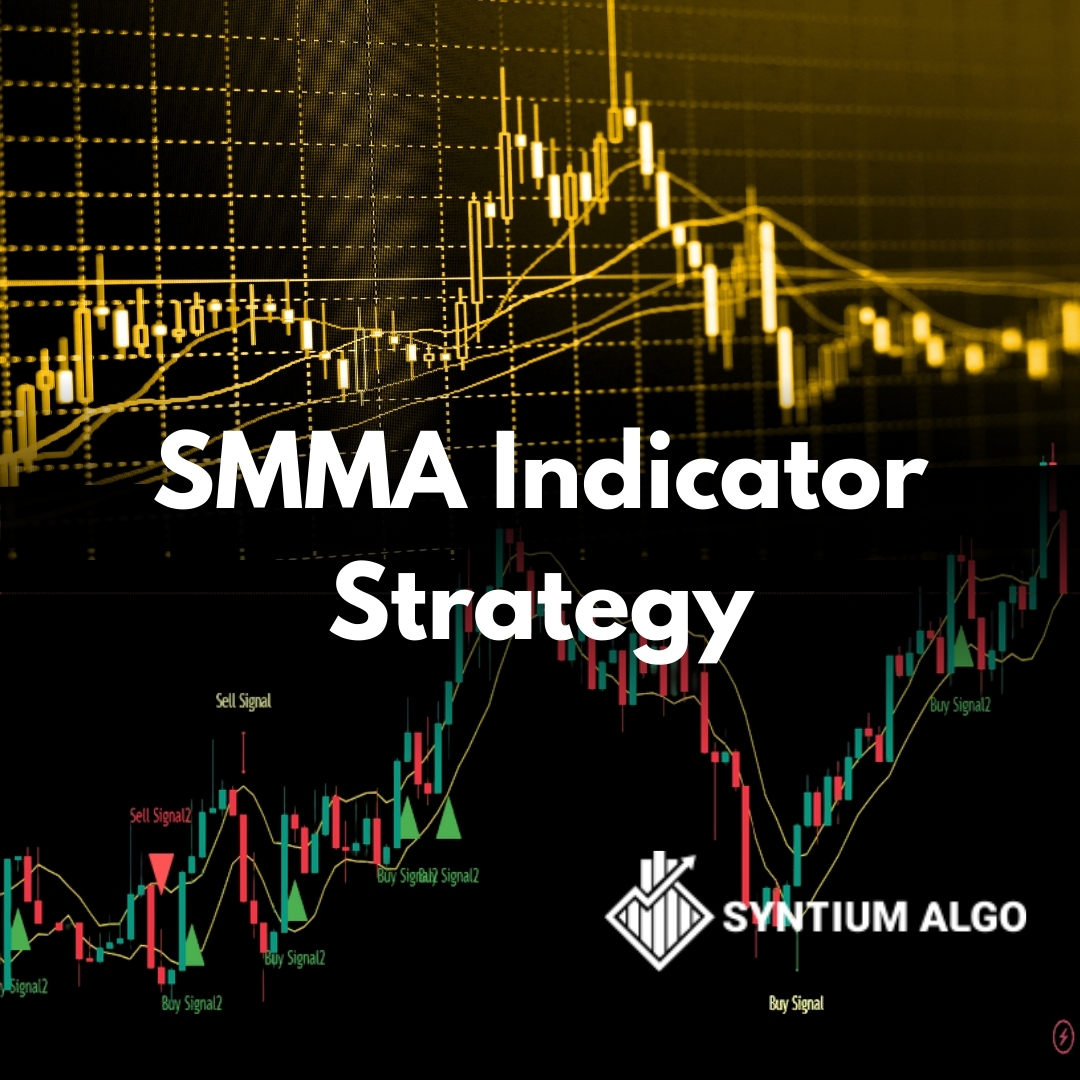
The SMMA indicator strategy is designed for traders who value clarity over speed. In markets filled with noise, fake breakouts, and short-term volatility, many fast-moving indicators generate more confusion than confidence. The Smoothed Moving Average (SMMA) takes a different approach by focusing on the bigger picture, helping traders identify genuine market direction and stay aligned with dominant trends.
For modern traders, especially those using Syntium Algo, SMMA plays an important role in filtering low-quality signals and confirming trend strength. When combined with advanced analytics and automation, SMMA becomes far more than a simple moving average, it becomes a reliable trend foundation.
What Is the SMMA Indicator? (Smoothed Moving Average)
The Smoothed Moving Average (SMMA) is a trend-following indicator that blends the stability of a Simple Moving Average with the responsiveness of an Exponential Moving Average. Unlike SMA, which treats all data points equally, or EMA, which heavily priorities recent price action, SMMA distributes weight across the entire historical dataset while still slightly favouring recent prices.
This structure results in a smoother, less reactive line that moves steadily with the market. The SMMA indicator strategy is especially useful for traders who want to avoid over trading and focus on sustained price movements rather than short-term fluctuations.
How the SMMA Indicator Differs from SMA and EMA
Understanding the differences between SMMA, SMA, and EMA is critical before applying any strategy. SMA reacts slowly and often lags during trend changes. EMA reacts quickly but is prone to whipsaws in volatile or ranging markets. SMMA sits between these two extremes.
SMMA filters market noise more effectively than EMA and responds faster than SMA during long-term shifts. This balance makes it ideal for confirming trend direction rather than predicting every minor price swing. Syntium Algo leverages this smoothing behavior within its AI trend detection logic to maintain stability during unpredictable market conditions.
Why the SMMA Indicator Strategy Works for Trend Traders
The strength of the SMMA indicator strategy lies in its patience. It does not attempt to catch every move; instead, it focuses on high-probability trends that persist over time. This helps traders remain in winning trades longer and avoid emotional exits triggered by minor pullbacks.
By smoothing out price action, SMMA allows traders to assess whether the market is genuinely trending or simply fluctuating. This is especially valuable in forex and crypto markets, where sudden volatility spikes often mislead faster indicators.
How to Apply the SMMA Indicator Strategy in Real Trading
A practical SMMA indicator strategy begins with trend identification. When price remains consistently above the SMMA, it signals bullish market conditions. When price stays below the SMMA, bearish conditions dominate. Traders use this relationship as a directional filter rather than an entry trigger.
Entries are typically aligned with pullbacks toward the SMMA within an established trend. Exits occur when price decisively crosses the SMMA or when AI-based confirmation tools signal weakening momentum. Syntium Algo enhances this approach by validating SMMA-based signals with volatility analysis and AI breakout detection.
Best SMMA Settings for Different Trading Styles
SMMA performs best with longer periods, but the optimal setting depends on trading style. For swing traders, periods between 20 and 50 offer a balance between responsiveness and smoothness. Position traders often prefer SMMA values above 100 to capture major market cycles.
Short-term traders can still use SMMA as a higher-timeframe filter while executing trades on lower timeframes. This multi-timeframe approach helps align short-term decisions with broader market direction, reducing the likelihood of countertrend trades.
Using SMMA with AI Trend Detection
On its own, SMMA is a static indicator. When combined with AI, it becomes adaptive. AI systems analyze how SMMA behaves across different volatility regimes and adjust interpretation dynamically. This reduces lag during strong trends and prevents false signals during consolidation phases.
Syntium Algo integrates smoothed trend filters like SMMA into its AI-driven models. These models evaluate price structure, volatility, and momentum together, ensuring that SMMA signals are only acted upon when market conditions support them.
SMMA Indicator Strategy in Forex and Crypto Markets
Forex and crypto markets are particularly well-suited for SMMA-based strategies due to their tendency to form extended trends. In forex, SMMA helps traders remain aligned with macro-driven movements influenced by interest rates and economic cycles.
In crypto, where volatility is higher, SMMA acts as a stabilizing force. It filters erratic price behavior and highlights meaningful trend transitions. Syntium Algo applies SMMA-style smoothing alongside AI volume and volatility analysis to adapt to crypto’s unique market structure.
Common Mistakes Traders Make with SMMA
One common mistake is using SMMA as a standalone entry signal. SMMA works best as a confirmation tool, not a trigger. Another error is applying it in ranging markets, where price frequently crosses the average without meaningful direction.
Traders also tend to over-optimize SMMA settings, adjusting parameters excessively to fit past data. This often leads to poor real-time performance. Syntium Algo avoid this pitfall by adapting models automatically instead of relying on fixed optimization.
How Syntium Algo Enhances the SMMA Indicator Strategy
Syntium Algo enhances the SMMA indicator strategy by embedding it within a broader AI framework. Instead of relying solely on price crossings, the platform evaluates trend strength, volatility regimes, and momentum shifts before validating SMMA-based signals.
This approach ensures that SMMA is used in favorable conditions while avoiding periods where smoothing alone is insufficient. By combining SMMA with AI breakout signals, reversal detection, and algorithmic risk management, Syntium Algo transforms a classic indicator into an institutional-grade trend tool.
SMMA Indicator Strategy vs Faster Moving Average Strategies
Faster moving averages excel in short-term trading but often struggle during volatile or choppy markets. SMMA sacrifices speed for reliability, making it better suited for traders focused on consistency rather than frequency.
In trending environments, SMMA keeps traders aligned with the dominant move while faster averages generate premature exit signals. This makes SMMA particularly valuable when paired with AI systems that manage timing and risk dynamically.
Is the SMMA Indicator Strategy Worth Using in 2026?
The SMMA indicator strategy remains highly relevant in 2026, especially when combined with AI-driven analysis. Its ability to smooth noise, confirm long-term trends, and reduce emotional trading makes it a powerful foundation for modern strategies.
When enhanced with advanced analytics and automation from Syntium Algo, SMMA evolves from a traditional indicator into a reliable component of intelligent trading systems. For traders seeking stability, accuracy, and consistency, SMMA remains a timeless tool, modernized by AI.
FAQs
What is the SMMA indicator best used for?
It is best for identifying and confirming long-term market trends.
Is SMMA better than EMA?
SMMA is smoother and more reliable for trend confirmation, while EMA reacts faster.
What timeframe works best for SMMA?
Higher timeframes produce the most reliable SMMA signals.
Can SMMA be automated in trading systems?
Yes, it integrates well with algorithmic and AI-driven strategies.
Does Syntium Algo use SMMA-based logic?
Yes, smoothed trend filters are incorporated within Syntium’s AI models.