Disclaimer: Syntium Algo and all affiliated parties are not registered as financial advisors. The information provided on this site, along with the products and services offered by Syntium Algo, are intended for educational purposes only and should not be interpreted as financial advice. It is important to understand the risks involved in trading and be willing to accept any level of risk when investing in financial markets. Please note that past performance is not necessarily indicative of future results. Syntium Algo and all individuals associated with the company has no responsibility for your trading results or invest decisions. It is recommended to conduct through research, seek professional advice, and carefully consider your financial situation before making any trading or investment decisions.
Why Volatility Forecasting Now Shapes the Future of Forex
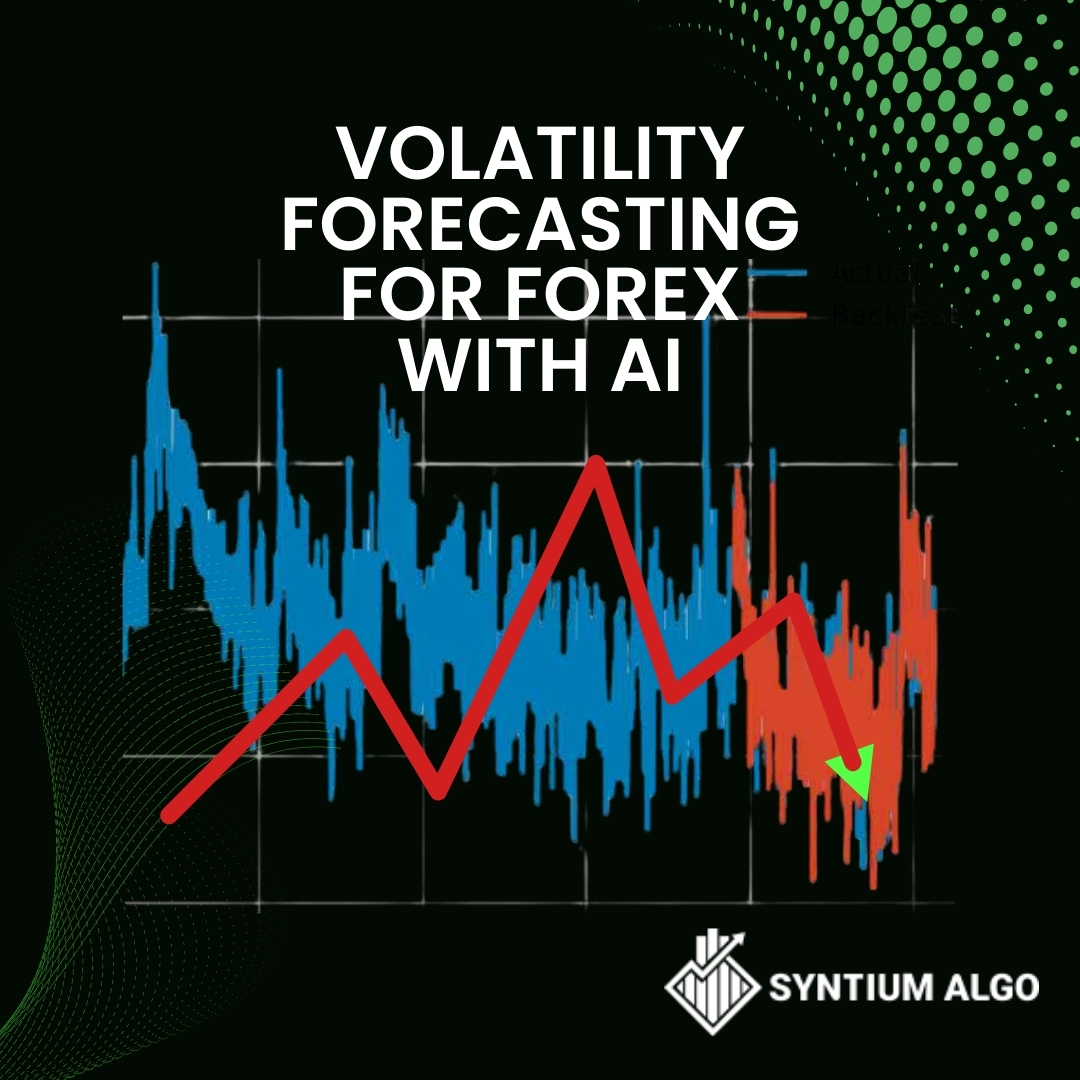
Volatility is no longer just a background element of the forex market, it is the driving force behind price movement, liquidity cycles, market manipulation, and institutional positioning. As macroeconomic shocks and algorithmic trading increase market speed, Volatility Forecasting for Forex has become a necessity for both retail and institutional traders. Forecasting volatility allows traders to anticipate price expansion, identify low-risk entries, and adjust position sizing based on expected turbulence.
What used to be a skill reserved for quants is now accessible to everyday traders. The rise Syntium Algo gives traders predictive volatility metrics, real-time regime detection, and algorithmic risk management that adapts instantly to market conditions. This shift is why volatility forecasting is becoming core to modern trading strategies, just like how breakout traders rely on AI breakout signals.
What Is Volatility Forecasting for Forex?
Forex volatility forecasting refers to predicting future price variability using quantitative models, statistical patterns, and AI-driven machine learning. Rather than reacting to randomness, traders anticipate:
- When markets will expand
- When volatility will contract
- When breakout conditions form
- When risk levels rise or fall
- When liquidity conditions change
The goal isn’t predicting exact price movements, but forecasting the intensity of future movement. Volatility forecasting answers questions like: “Will EUR/USD stay quiet or explode this session?” “Is GBP/USD preparing for a news-driven volatility spike?” “Is USD/JPY transitioning from consolidation to expansion?”
Traditional indicators- ATR, Bollinger Bands, or standard deviation– only measure past movement. AI models, however, learn from historical + real-time conditions to predict volatility before it happens. This is why traders using Syntium Algo gain a major edge: predictive volatility metrics can forecast regime shifts ahead of time, enabling smarter risk allocation and position sizing.
Why Volatility Matters More in Forex Than Any Other Market
Forex is uniquely sensitive to volatility because it reacts to- interest rate decisions, economic data releases, geopolitical tension, institutional hedging, and global liquidity cycles. Unlike equities, forex trades 24 hours a day. Volatility clusters tend to form during:
- market opens (London, New York)
- high-impact news events (CPI, NFP, FOMC)
- unexpected macro shocks
Forecasting volatility helps traders:
- Avoid entering positions before news spikes
- Size positions based on expected risk
- Trade breakouts only when momentum is confirmed
- Detect low-volatility traps that cause false signals
- Manage trailing stops using volatility-based logic
This is exactly why Syntium Algo integrates AI volatility clustering into every model. It helps detect when volatility is artificially compressed, signaling potential explosive breakouts, useful for strategies based on AI breakout signals, AI reversal signals, or order flow-driven scalping methods.
Traditional Volatility Forecasting Models
Most retail traders rely on simple volatility indicators. But professional models, used by hedge funds, go much further. Here are the foundational models behind Volatility Forecasting for Forex:
1. Historical Volatility (HV)
Measures past price movement to estimate the market’s average variability.
Strength: simple, widely used.
Weakness: reactive, not predictive.
2. ATR (Average True Range)
ATR reveals market noise and stop-loss distances.
Strength: great for risk management.
Weakness: does not forecast volatility spikes.
3. GARCH Models
Generalized Autoregressive Conditional Heteroskedasticity.
Used heavily in institutional quant trading.
Strength: forecasts future volatility clusters.
Weakness: requires advanced modeling.
4. Implied Volatility (IV)
Derived from options pricing.
Strength: forward-looking.
Weakness: limited in spot forex.
5. Economic Calendar-Based Volatility Prediction
Events like NFP or CPI have predictable volatility impacts.
Strength: reliable for session forecasting.
Weakness: requires statistical event modeling.
How AI Transforms Volatility Forecasting for Forex
AI volatility forecasting inside Syntium Algo includes:
AI Volatility Cluster Detection: AI identifies zones where volatility is artificially compressed—a precursor to explosive breakouts. AI Liquidity & Order Flow Forecasting: Predicts how institutions may position themselves before volatility spikes. News-Based Volatility Mapping: Real-time sentiment analysis helps forecast news reactions. Regime Classification Models
AI detects:
- trending volatility
- mean-reverting volatility
- expansion → contraction transitions
- contraction → expansion transitions
How Volatility Forecasting Helps Forex Traders in Real Market Conditions
Volatility forecasting enables traders to anticipate the rhythm of the market before entering a position. When volatility is expected to contract, traders know that breakouts are unlikely and can avoid false entries. When volatility is predicted to expand, traders can prepare for momentum-driven moves and adjust their strategies accordingly. This foresight transforms the way traders manage entries, exits, and risk exposure across all major currency pairs.
At the same time, volatility forecasting helps reduce uncertainty during high-impact sessions. Instead of guessing how NFP or CPI data might affect the market, traders rely on AI models that monitor sentiment and liquidity reactions in real time. This results in more stable decision-making, fewer emotional mistakes, and greater consistency across different market regimes. Syntium Algo enhances this with real-time volatility clustering, giving traders actionable insights that translate into stronger performance.
Real Forex Examples: How Volatility Forecasting Changes Trading Outcomes
Consider EUR/USD during the overlap between the London and New York sessions, a period known for high liquidity and sharp volatility spikes. Without volatility forecasting, a trader may enter during a consolidation phase, expecting a breakout that never arrives. AI forecasting models, however, detect whether order flow and volatility patterns support expansion, helping traders avoid unnecessary exposure. This allows a strategy to align with market rhythm instead of fighting against it.
Similarly, GBP/USD often reacts violently to unexpected macro news. A trader relying purely on price action may be caught off-guard by sudden volatility changes that wipe out tight stop-losses. Forecasting these volatility surges in advance helps traders widen stops, reduce position size, or avoid trading altogether. Syntium Algo’s AI volatility mapping provides these early signals, allowing traders to stay proactive instead of reacting late to market shocks.
Common Mistakes Traders Make When Forecasting Volatility
Many traders rely solely on ATR or Bollinger Bands and assume they understand volatility, but these tools only describe the past. As a result, they make decisions based on outdated information and misinterpret volatility compression or expansion. Traders often enter breakout trades during low-volatility conditions, not realizing the market lacks the energy needed for follow-through. This leads to frustration, premature exits, and missed opportunities.
Another common mistake is ignoring how news events distort volatility. Without forecasting tools, traders fail to anticipate whipsaws and place their stops too close before major announcements. They also overlook cross-pair volatility relationships, such as how USD strength impacts different forex majors simultaneously. Syntium Algo helps eliminate these mistakes through real-time AI volatility mapping, which provides a clearer understanding of market phases and their potential impact.
How do traders forecast volatility in forex?
They use ATR, standard deviation, GARCH models, and AI tools that predict future volatility shifts.
Is volatility forecasting accurate for forex trading?
Accuracy improves significantly when using AI-driven predictive analytics instead of traditional indicators.
Why is volatility forecasting important before entering a trade?
It helps traders understand risk levels and choose entries aligned with expected price movement.
Can volatility forecasting help reduce losses?
Yes, by adjusting stop-losses, position size, and avoiding high-risk volatility spikes.
Does volatility forecasting work for both beginners and experienced traders?
It benefits both, offering clarity for beginners and precision for advanced traders.
Is volatility forecasting effective for crypto and indices too?
Yes, the same predictive volatility principles apply across forex, crypto, and index markets.