Disclaimer: Syntium Algo and all affiliated parties are not registered as financial advisors. The information provided on this site, along with the products and services offered by Syntium Algo, are intended for educational purposes only and should not be interpreted as financial advice. It is important to understand the risks involved in trading and be willing to accept any level of risk when investing in financial markets. Please note that past performance is not necessarily indicative of future results. Syntium Algo and all individuals associated with the company has no responsibility for your trading results or invest decisions. It is recommended to conduct through research, seek professional advice, and carefully consider your financial situation before making any trading or investment decisions.
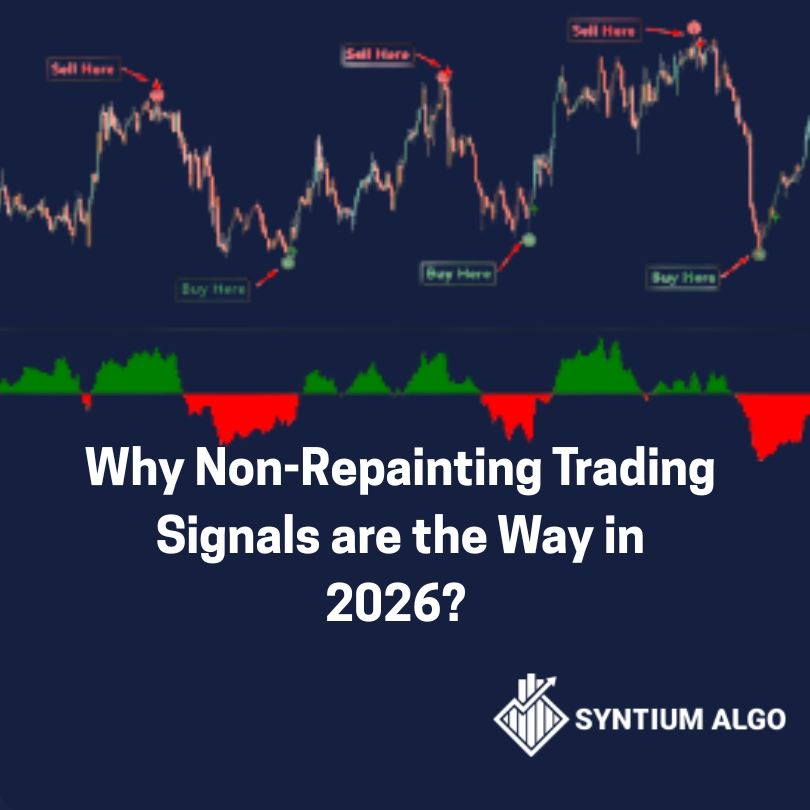
In a world of high-frequency “Agentic” execution, non-repainting trading signals are no longer just a luxury, they are a requirement. At Syntium Algo, we build our infrastructure on honesty, ensuring that the signal you see is the signal that stays.
The trading landscape of 2026 is faster and more unforgiving than ever before. For many retail traders, the biggest hurdle isn’t the market’s direction, but the tools they use to predict it. If you have ever seen a “perfect” buy signal on a historical chart only to watch it vanish in real-time, you have been a victim of repainting.
The “Phantom Signal” Crisis: Why Repainting Kills Accounts
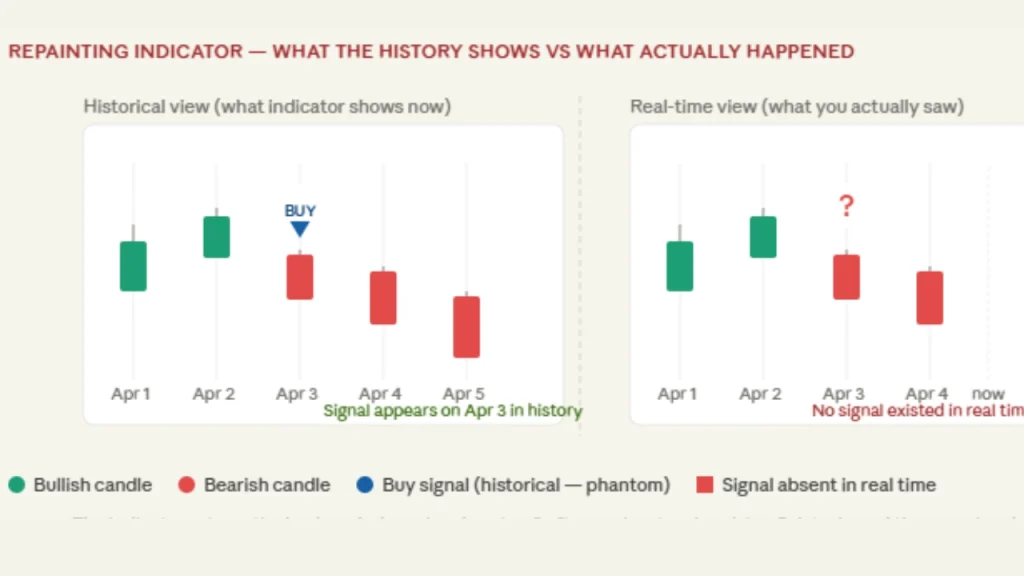
Repainting occurs when an indicator “cheats” by using future data to change past signals. An arrow might appear when the price goes up, but if the market reverses, that arrow disappears. This makes a strategy look 100% accurate in hindsight but results in consistent losses in live trading.
By the time you click “buy,” the signal has vanished, leaving you in a losing position. To combat this, Syntium Algo utilizes Closed-Bar Confirmation. This means a signal is only printed once a candle is 100% complete. This provides a permanent record you can actually trust.
How to check if your indicator repaints (step-by-step)
Most traders discover repainting the hard way, after a losing trade where they swear the signal was pointing the other way. The good news is that testing any indicator for repainting takes less than five minutes on TradingView. Here is exactly how to do it.
Step 1: Apply the indicator to a historical chart
Open TradingView and load any chart you regularly trade — EUR/USD on the 4H timeframe works well for this test. Apply the indicator you want to test and scroll back at least 3 to 6 months into historical data. You want to see a section of chart with clear buy and sell signals already printed. Take a screenshot or note the exact position of two or three signals on specific candles.
Step 2: Zoom into a specific past signal
Find a clearly visible buy or sell arrow from several weeks ago. Zoom in until that candle fills most of your screen. Note precisely which candle the signal is sitting on. Write down the date, time, and price level. This is your reference point. If the indicator is non-repainting, this signal will never move from this candle, no matter what happens next.
Step 3: Switch to a different timeframe and switch back
This is where repainting exposes itself. Change your chart from 4H to 1H, wait a few seconds, then switch back to 4H. Check whether your reference signal is still sitting on the exact same candle at the exact same position. Now repeat this with the Daily timeframe, then return to 4H again. A repainting indicator will shift signals, delete them entirely, or move them to slightly different candles during these switches because it is quietly recalculating using data that was not available when the signal originally appeared.
Step 4: Let the chart run forward in real time
If you want to be absolutely certain, use TradingView’s bar replay feature. Set it to start just before your reference signal appeared and let it play forward candle by candle. A non-repainting indicator will print the signal only when the candle fully closes and will never alter it as subsequent candles form. A repainting indicator will often show a signal mid-candle that vanishes or moves the moment the next candle opens. This is the “phantom arrow” effect in action and it is the reason that indicators which look perfect in backtests produce consistent losses in live trading.
If your indicator fails any of these steps, it is repainting. No amount of optimisation will fix this fundamental flaw, because the problem is architectural, the indicator is using future price data to determine past signals. Syntium Algo’s closed-bar confirmation means every signal is calculated only once a candle is 100% complete, making it immune to all four of these failure points.
Repainting vs non-repainting: what you actually see on the chart
The difference between a repainting and non-repainting indicator is not subtle once you know what to look for. The chart below illustrates exactly what each type of signal looks like in the same market conditions.
The Syntium Edge: Gaussian Filters and Automated Logic
Most “stable” indicators are incredibly laggy, giving you signals after the move is already over. Syntium Algo solves this balance through two core technologies:

1. Gaussian Smoothing (ALMA)
We replace standard, jittery moving averages with Gaussian-smoothed filters like the ALMA. This allows our non-repainting trading signals to stay tight to the price action while filtering out the “noise” of 2026’s volatile micro-swings. You get the speed of a leading indicator with the stability of a lagging one.
2. Fully Automated Signals
In 2026, you cannot afford to sit at a desk for 12 hours. Syntium Algo provides automated signals delivered directly to your devices. Whether it is through TradingView webhooks or real-time Telegram alerts, our system monitors the charts for you, executing your “Intent” with machine-like discipline.
24/7 Availability: Trading the Global Clock
The markets never sleep, and neither does your edge. Syntium Algo offers 24/7 availability. Our cloud-based agents monitor global Forex, Crypto, and Index markets around the clock. Whether a breakout happens during the London open or the Tokyo mid-session, your non-repainting trading signals will be there to catch the move.
Why Transparency is Your Only Path to the 10%
The “10%” of profitable traders don’t look for “holy grail” bots; they look for reliable data. When you use non-repainting trading signals, you can accurately backtest your strategy. You see the wins, but more importantly, you see the losses. This transparency allows you to manage your risk and stay under your maximum drawdown, which is the key to passing prop firm challenges in 2026.
FAQs
1. What are non-repainting trading signals?
These are signals that, once printed on a closed candle, never change, move, or disappear. They provide a fixed, honest record of market entries.
2. Why is “Closed-Bar Confirmation” important?
It ensures that the indicator has all the data for that specific time period before making a decision. This prevents the “Time Travel” error found in many retail indicators.
3. Does Syntium Algo work on all timeframes?
Yes. Our non-repainting trading signals are effective from the 1-minute scalping charts to the weekly swing-trading candles.
4. How do I access the automated signals?
Once you start your free trial, you can set up real-time alerts via TradingView or Telegram. Our system provides 24/7 availability, so you never miss a setup.
5. Is Gaussian smoothing better than a standard EMA?
Absolutely. Gaussian smoothing (like ALMA) provides a much better balance between lag and signal quality, making it ideal for the high-speed 2026 environment.
6. Can I use these signals for Prop Firm challenges?
Yes. Because our signals are non-repainting, you can build a reliable risk management plan that keeps you within the strict drawdown limits required by modern prop firms.