Disclaimer: Syntium Algo and all affiliated parties are not registered as financial advisors. The information provided on this site, along with the products and services offered by Syntium Algo, are intended for educational purposes only and should not be interpreted as financial advice. It is important to understand the risks involved in trading and be willing to accept any level of risk when investing in financial markets. Please note that past performance is not necessarily indicative of future results. Syntium Algo and all individuals associated with the company has no responsibility for your trading results or invest decisions. It is recommended to conduct through research, seek professional advice, and carefully consider your financial situation before making any trading or investment decisions.
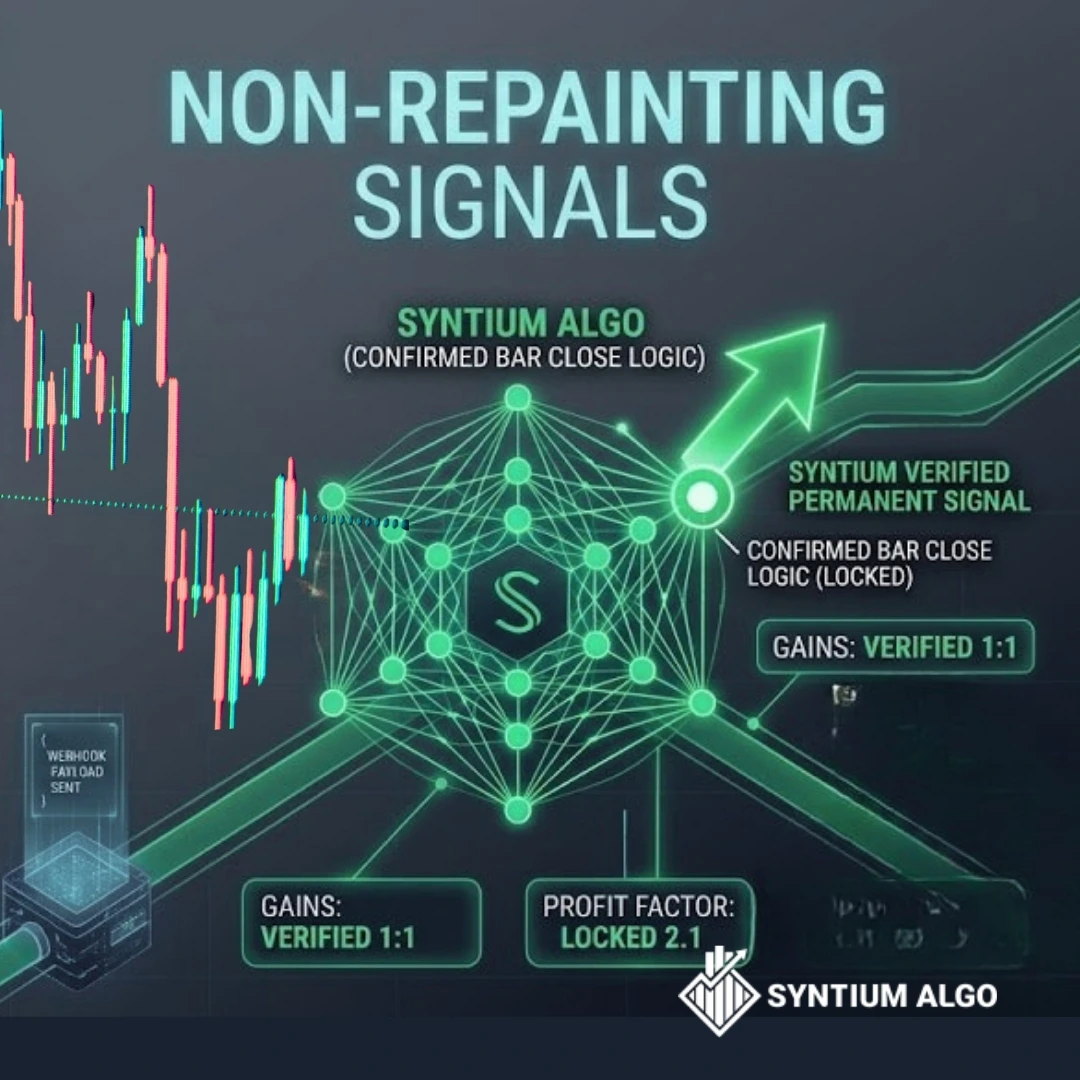
The backtest looks like a vertical staircase to heaven. There are zero drawdowns, a 95% win rate, and every single buy arrow sits perfectly at the absolute bottom of every market swing. Elated by the historical data, a trader plugs the script into a live account, connects the webhook API, and goes to sleep. By morning, the account has suffered severe capital loss. This isn’t a rare occurrence; it is the standard script for retail algorithmic failure. The culprit isn’t bad luck or sudden market volatility. It is a mathematical illusion caused by repainting indicators. To survive the fast-shifting environments of the modern market, moving past the smoke and mirrors is crucial. Relying on Non-Repainting Signals isn’t just an option, it is a mandatory requirement for algorithmic survival.
The Core Concept: The Difference Between “Plotting” and “Predicting”
To understand why a backtest can be completely disconnected from reality, a trader must understand the structural difference between standard retail scripts and professional automation engines.
[Live Candlestick Forms] ──> [Price Drops Violently] ──> [Repainting Script: Deletes the Signal]
                                                    └──> [Syntium Engine: Locks the Real-Time Loss]
Many popular commercial indicators are engineered backwards. They look at a completed chart historically, compute where the ideal turning point was, and retroactively place an arrow on that past candle. In programming terms, this is often caused by scripts that fetch future data or use unconfirmed bars to plot structural key levels.
When you look at the chart on weekends, it looks flawless. But when the chart is live, the script prints a buy arrow, price crashes, and the script simply deletes or shifts the arrow to the next candle down. It essentially erases its own losses from history.
Why True Automated Pipelines Demand “Confirmed Hard-Coding”
If a quantitative system relies on signals that shift or disappear, the entire infrastructure of your trading pipeline collapses.
1. The Broken Webhook Chain
Automated trading relies on a clean, binary chain of command. An alert triggers on your chart, the text payload is transmitted via a server-to-server webhook, and your exchange API bridge instantly routes an order.
- The Flaw: If an indicator prints a temporary signal that triggers an exchange order, but then disappears from your chart ten minutes later because price kept falling, your chart will show “no trade” while your actual exchange account is bleeding capital in a live, unmanaged position.
- The Syntium Fix: By prioritizing strict Non-Repainting trading Signals, the execution code locks down. A signal cannot physically print until the exact candle close condition is satisfied (
barstate.isconfirmed). What triggers your API is permanently engraved on the chart forever.
2. The Statistical Illusion of the Profit Factor
When evaluating an algorithmic strategy, the most critical metric is its Profit Factor (the gross profit divided by the gross loss). Repainting indicators artificially inflate this number by wiping out historical losses.
- The Flaw: An unverified strategy might show an incredible Profit Factor of 3.5 in backtesting. Once deployed live, because the real losses are finally forced to stay on the book, that metric can plummet to a sub-optimal 0.5.
- The Syntium Fix: True risk management requires knowing your precise trade expectancy. Non-Repainting Signals force your backtests to be 100% honest. You see the exact wins, but more importantly, you see the exact, unfiltered losses, giving you the accurate data needed to size your positions safely.
The Technical Framework of an Honest Entry Engine
Building a strategy that survives live execution requires shifting away from dynamic historical recalculations and embracing fixed multi-factor confirmation layers.
| Engine Metric | Repainting “Smoke & Mirrors” Bots | Non-Repainting (Syntium Algo) Systems |
| Historical Data Use | Pulls unconfirmed “future” bar data | Restricts calculations strictly to closed, past metrics |
| Signal Stability | Arrows shift, recalculate, or vanish completely | Signals lock permanently once printed on a closed bar |
| Risk Management | Dynamic stop-loss targets move retroactively | Fixed invalidation zones project instantly at entry |
| Backtest Validity | Artificially smoothed; entirely unreliable | 1:1 match with real-time execution records |
Moving Beyond “Look-Back” Delays with Advanced Filtration
A major argument retail developers make in defense of repainting logic is that non-repainting systems are “too slow” or lag behind price. They claim that waiting for a candle to fully close before printing a signal forces an entry too late into the move.
While this is true for standard, unweighted indicators like a basic Exponential Moving Average, modern systems bypass this delay using advanced distribution math. Instead of forcing a script to guess the future, Syntium Algo implement Gaussian smoothing filters (such as the ALMA).
Gaussian smoothing applies a weighted mathematical distribution to historical price fields, filtering out high-frequency noise and sudden session-transition sweeps without introducing heavy lag. This allows the signal engine to track price action closely while maintaining strict non-repainting parameters. You get the execution speed of a leading indicator alongside the hard-coded permanence required for automated webhooks.
The Bottom Line: Trade What is Present
Successful systematic trading is not about creating a flawless, hypothetical past; it is about managing an imperfect, live present. If an algorithm relies on tools that hide their mistakes, it is impossible to build a sustainable statistical edge.
Before deploying capital or connecting an API bridge to any strategy, demand transparency. Insist on verification models where every arrow, target zone, and stop-loss boundary is anchored firmly to closed-bar data. Protect your trading pipeline, avoid the curve-fitting traps, and base your execution on stable, non-repainting infrastructure.
FAQs
What are Non-Repainting Signals?
These are entry or exit alerts that lock permanently onto a closed chart candle. They never change position, blink, or vanish after the bar closes.
Why do standard indicators repaint?
Many retail scripts cheat by recalculating past data using future price action. They retroactively place arrows only on winning historical zones to look perfect.
How does repainting damage automated trading?
A repainting script triggers an execution order on your exchange bridge via webhooks. If the signal then vanishes from the chart, your live trade runs unmanaged without an active exit plan.
Does a non-repainting system cause entry lag?
Standard moving averages cause lag, but advanced algorithms solve this problem. Syntium Algo uses Gaussian smoothing filters to provide fast entries while keeping signals permanent.
How do Non-Repainting Signals improve backtesting?
They force your historical test results to match live market trading exactly. You see the true wins and the real losses, which lets you calculate your actual profit factor.
Can I trust a strategy with a high win rate?
No, a high win rate is often a psychological trap. A script can win 70% of the time but still blow up an account if its average loss is four times larger than its average win.
Best Crypto Trading Signals in 2026: How to Pick Real Ones (and Skip the Scams) - Syntium Algo
[…] Signals don’t repaint. Some indicators change past signals after the candle closes, which makes backtests look perfect. Learn how to spot this in our guide to non-repainting signals. […]