Disclaimer: Syntium Algo and all affiliated parties are not registered as financial advisors. The information provided on this site, along with the products and services offered by Syntium Algo, are intended for educational purposes only and should not be interpreted as financial advice. It is important to understand the risks involved in trading and be willing to accept any level of risk when investing in financial markets. Please note that past performance is not necessarily indicative of future results. Syntium Algo and all individuals associated with the company has no responsibility for your trading results or invest decisions. It is recommended to conduct through research, seek professional advice, and carefully consider your financial situation before making any trading or investment decisions.
What Is the Ultimate Oscillator? (Explained Simply)
Choosing the best Ultimate Oscillator settings starts with understanding why the indicator was created in the first place. The Ultimate Oscillator was designed by technical analyst Larry Williams to solve a major flaw in traditional oscillators: reliance on a single timeframe. Short-term oscillators move too quickly and generate noise, while long-term oscillators react too slowly and miss early reversal points. By combining three lookback periods into one balanced momentum reading, the Ultimate Oscillator delivers a clearer and more reliable view of real buying pressure.
By analysing price action across short, medium, and longer cycles, the indicator gives a more balanced signal. It avoids the whipsaws seen during low-volume sessions and the lag that occurs during momentum surges. This makes it especially effective in forex and crypto, where market sentiment shifts rapidly.
How the Ultimate Oscillator Works
At its core, the Ultimate Oscillator measures buying pressure, a concept that compares the closings and lows of recent price bars to determine whether real directional strength exists. It then blends this buying pressure across 7-, 14-, and 28-period cycles. The shorter period reacts quickly, the middle period confirms, and the longer period provides overall trend context.
This three-level structure reduces the chance of false reversals and smooths out erratic price movements. The result is a more accurate reading of market momentum, especially when combined with price structure and volume behaviour. Because of this reliability, many traders rely on the best Ultimate Oscillator settings when identifying early trend reversals or confirming existing trends.
Best Ultimate Oscillator Settings for Different Trading Styles
The effectiveness of the Ultimate Oscillator depends heavily on the settings you choose. While the default 7-14-28 periods are popular, different styles of trading require different sensitivity levels. Faster settings help day traders react to quick intraday reversals, while slightly slower settings help swing traders capture multi-day momentum shifts without being shaken out by noise.
Traders should match their settings to volatility, market conditions, and personal strategy. In fast-moving markets like crypto, adjusting the short-term period may produce more responsive signals. In slower-moving forex pairs, smoothing the indicator slightly can improve its stability.
Choosing the right settings is not about finding a perfect formula, it’s about aligning momentum behaviour with the time horizon you trade.
Recommended Settings for Day Trading
Day traders benefit from faster oscillation because intraday conditions change rapidly. Shorter lookback periods allow the indicator to detect small bursts of buying pressure and early signs of exhaustion. This is important when trading during high-volume sessions or after major news events.
Shorter settings capture momentum early, but they also increase noise. This is where AI-powered validation becomes valuable. Syntium Algo analyses order-flow behaviour, volatility clusters, and volume pressure to determine whether a fast momentum spike is meaningful or simply market noise. The combination of responsive settings and AI confirmation gives day traders a cleaner, more precise signal.
Recommended Settings for for Swing Trading
Swing traders generally benefit from best Ultimate Oscillator settings that filter intraday noise and focus on the broader momentum wave. A slightly longer short-term period helps stabilise the Ultimate Oscillator during multi-day consolidations, where quick spikes can easily mislead.
Swing trading setups rely heavily on divergence, trend continuation, and higher-timeframe structure. Longer settings improve the clarity of these signals and help reduce false reversals. Many swing traders also combine the Ultimate Oscillator with tools such as Connors RSI or volatility-based stops to add further confirmation. Syntium Algo enhances this approach by analysing multi-timeframe order flow and detecting whether the momentum shift is supported by actual buying pressure.
Ultimate Oscillator Buy & Sell Signals (Interpretation Guide)
The Ultimate Oscillator produces actionable signals when used correctly, but interpretation matters more than simply reacting to a number. Overbought and oversold levels create potential turning points, but the strongest signals occur when momentum aligns with trend direction.
Buy signals typically appear when the oscillator moves upward from oversold levels, especially if price forms a higher low at the same time. Sell signals appear when the indicator rolls over from overbought levels while price struggles to continue higher. These setups strengthen when supported by volume, structure, or multi-timeframe confluence.
Momentum indicators work best when used as confirmation rather than standalone triggers, and the Ultimate Oscillator is no exception.
Ultimate Oscillator Divergence Strategy
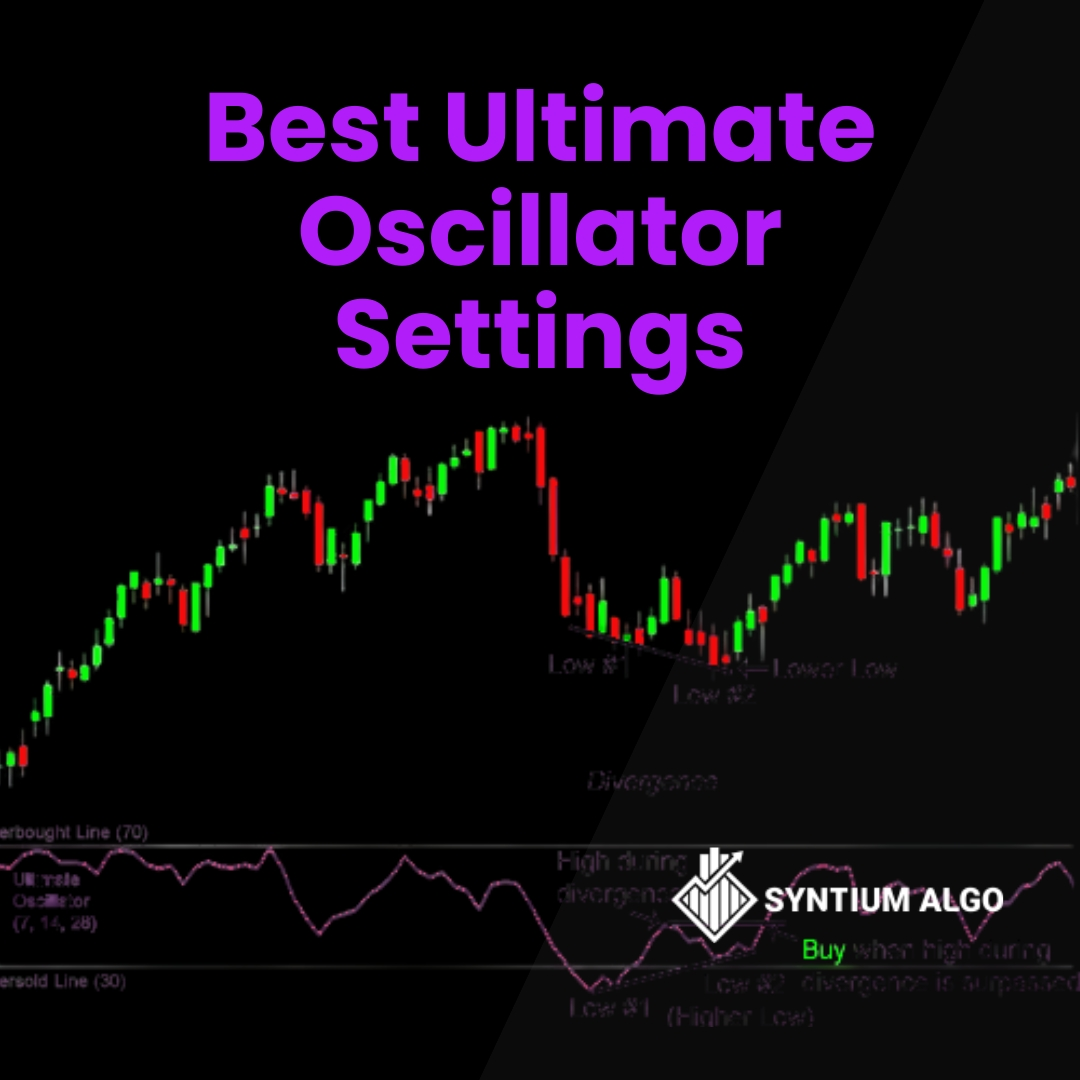
Divergence is one of the most powerful features of the Ultimate Oscillator. Bullish divergence forms when price makes a lower low while the oscillator makes a higher low. This suggests that downward momentum is weakening, often before price reverses. Bearish divergence forms when price makes a higher high while the oscillator prints a lower high, signaling weakening buying pressure.
Divergence works especially well with the Ultimate Oscillator because its multi-timeframe structure filters noise better than single-timeframe oscillators like RSI. Hidden divergence also becomes more reliable, helping traders catch continuation moves during retracements. Syntium Algo enhances divergence logic by confirming whether actual order flow supports the shift in momentum.
Ultimate Oscillator vs RSI: Which Is Better?
RSI is popular for its simplicity, but it relies on a single timeframe and often overreacts to sharp price movements. The Ultimate Oscillator uses three periods, smoothing out noise and creating more stable reversal signals. During choppy markets, the Ultimate Oscillator typically offers fewer false alarms than RSI.
RSI remains useful for quick overbought/oversold signals, but the Ultimate Oscillator provides a deeper view of buying pressure and momentum sustainability. When combined with AI-driven volume and volatility analysis from Syntium Algo, its accuracy improves even further.
Best Markets for the Ultimate Oscillator
The Ultimate Oscillator works well across major forex pairs like EUR/USD, GBP/USD, and USD/JPY, where stable liquidity helps momentum develop clearly. It also performs effectively in crypto markets, where volatility creates strong divergences and oversold conditions.
Indices and commodities benefit from the indicator’s multi-timeframe design because they often move in cyclical waves. In all markets, combining the Ultimate Oscillator with volume-based analysis or AI confirmation enhances reliability.
Common Mistakes Traders Make
Many traders misuse the indicator by applying the wrong settings for their timeframe. Overly short settings produce noise, while overly long settings create lag. Another common mistake is relying on every crossover or overbought/oversold reading without considering trend direction.
Momentum indicators should not be used in isolation. When traders ignore context such as support, resistance, volatility, and volume, they often enter reversals too early or too late. Proper risk management is also essential, especially in fast-moving markets where momentum can shift quickly.
How Syntium Algo Enhances UO-Based Trading Strategies
Syntium Algo enhances Ultimate Oscillator strategies by analysing real-time market conditions and confirming momentum behaviour with AI. The system evaluates whether momentum aligns with volume, order flow, and volatility. When multiple factors support the same direction, the probability of a successful trade increases significantly.
Syntium Algo’s automation allows traders to execute strategies based on these confirmations. This ensures trades are executed consistently without emotional interference. By integrating momentum signals with broader market intelligence, Syntium Algo makes Ultimate Oscillator strategies more effective and more stable across changing environments.
The Ultimate Oscillator Is Better With AI
The Ultimate Oscillator remains one of the most reliable momentum indicators because it captures multi-timeframe buying pressure better than most tools. Choosing the right settings is essential, but understanding how to interpret the indicator matters even more. When combined with AI-driven analysis, the Ultimate Oscillator becomes significantly more powerful and far more accurate.
Syntium Algo enhances this indicator through predictive modelling, volume analytics, and real-time momentum confirmation. This combination gives traders a smarter, more disciplined approach to trading momentum in forex, crypto, indices, and commodities.
FAQs
What are the best Ultimate Oscillator settings for day trading?
Faster settings help capture rapid intraday momentum shifts, especially in volatile markets.
What settings work best for swing trading?
Slightly smoother settings create clearer momentum waves and more reliable divergence signals.
Is the Ultimate Oscillator better than RSI?
The Ultimate Oscillator reduces noise by combining multiple timeframes, offering more stable signals than single-timeframe RSI.
How does divergence work with the Ultimate Oscillator?
Divergence occurs when price and momentum move in opposite directions, helping identify early reversals.
Can AI improve Ultimate Oscillator accuracy?
Yes. AI validates momentum shifts using volume, liquidity, and volatility data, reducing false signals.
Does the Ultimate Oscillator work in forex and crypto?
The indicator performs well in both markets, especially when paired with AI-enhanced analysis.