Disclaimer: Syntium Algo and all affiliated parties are not registered as financial advisors. The information provided on this site, along with the products and services offered by Syntium Algo, are intended for educational purposes only and should not be interpreted as financial advice. It is important to understand the risks involved in trading and be willing to accept any level of risk when investing in financial markets. Please note that past performance is not necessarily indicative of future results. Syntium Algo and all individuals associated with the company has no responsibility for your trading results or invest decisions. It is recommended to conduct through research, seek professional advice, and carefully consider your financial situation before making any trading or investment decisions.
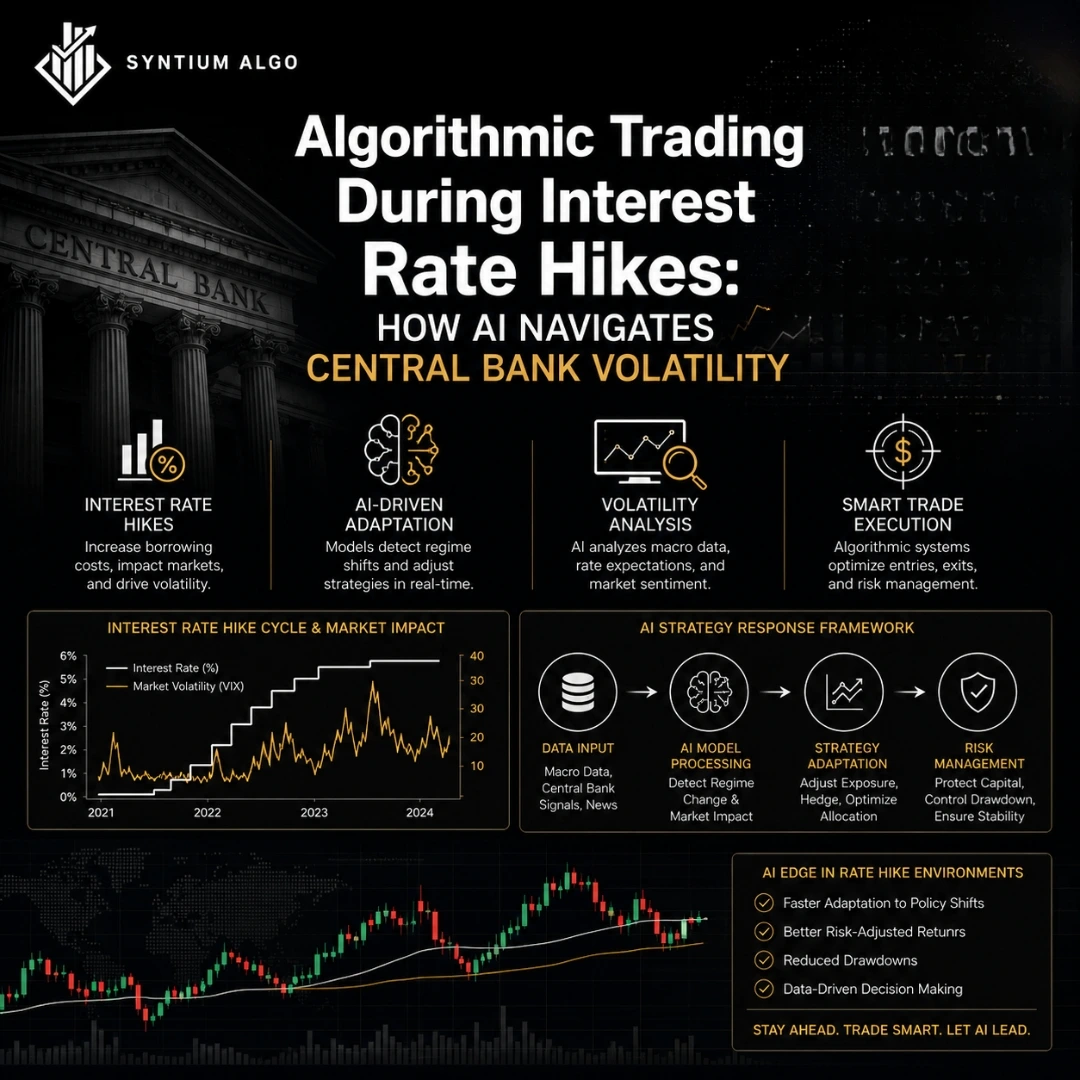
Navigating algorithmic trading during interest rate hikes has become one of the most vital disciplines for modern quantitative developers, especially when central bank announcements trigger sudden, explosive market shifts across global asset classes. You design an indicator that spots trend reversals or breakout setups with high promise, yet unexpected hawkish policy pivots constantly trigger stop-losses and eat away at your portfolio capital. The core challenge is that conventional trading models rely heavily on historical price direction, which leads to massive false-positive rates during macroeconomic regime shifts. Relying solely on lagging technical indicators forces automated algorithms to take low-probability entries during economic news releases that destroy long-term profitability. Without a smart, adaptive filtering system to separate structural policy trends from short-term market noise, even sophisticated quantitative strategies struggle to remain solvent during aggressive rate-tightening cycles.
Fortunately, integrating modern artificial intelligence frameworks into your automated trading engine provides a dynamic defense against monetary policy turbulence. Advanced Machine Learning (ML) models analyze macroeconomic datasets, inflation trends, and central bank communications in real-time, enabling trading bots to adapt instantly as economic forecasts change. Syntium Algo process central bank speeches, reconfigure risk boundaries, and execute high-probability orders during rate-hiking cycles.
Understanding the Impact of Central Bank Rate Hikes on Automated Trading
Central bank rate hikes represent structural shifts in economic policy designed to curb rising inflation by increasing the overall cost of capital. When central banks like the Federal Reserve or European Central Bank raise benchmark rates, borrowing slows down, asset valuations recalibrate, and liquidity shifts rapidly across currency, equity, and fixed-income markets. For quantitative algorithms, these policy changes alter fundamental market regimes, rendering static backtested parameters ineffective overnight.
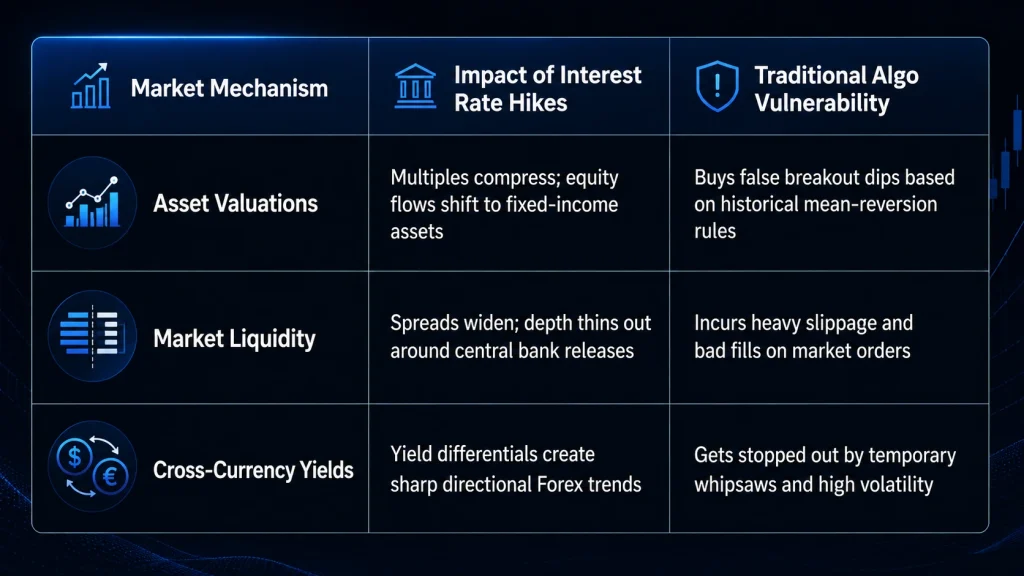
To maintain profitability, algorithms must account for how interest rate hikes alter market dynamics across multiple asset classes. Equity markets typically experience compressed valuation multiples and elevated sector rotation, while currency markets experience strong directional trends driven by widening interest rate differentials. Understanding these inter-market relationships allows quantitative models to rebalance exposure dynamically before volatility spikes occurs.
Shifts in Capital Flow and Liquidity
As borrowing costs rise, institutional capital migrates toward safer yield-bearing assets, thinning order book liquidity in riskier markets. Algorithms relying on deep market depth can suffer severe execution slippage if they do not account for liquidity contractions.
Increased Price Volatility and Spread Spikes
Central bank rate announcements spark rapid price swings as institutional market participants digest policy adjustments. Spread expansion during these events often triggers premature stop-losses for rigid, static trading bots.
Macro-Driven Market Regime Changes
Interest rate hikes transition markets from low-volatility accumulation phases into high-volatility, macro-driven trending regimes. Trading systems optimized strictly for range-bound conditions frequently fail during these prolonged macroeconomic shifts.
How Modern AI Models Process Interest Rate Announcements
Modern financial technology has evolved far beyond traditional moving averages and basic economic calendar alerts. Today, advanced artificial intelligence platforms process complex unstructured data to gauge central bank sentiment milliseconds after a policy document releases. By utilizing Natural Language Processing (NLP), AI systems read policy statements, compare word choices against previous releases, and determine whether a central bank leans hawkish or dovish.
This real-time textual analysis allows AI trading bots to evaluate the surprise factor in central bank rate decisions. Consequently, algorithms do not merely react to the headline interest rate number; they interpret the policy tone, forward guidance, and inflation outlook to predict multi-week market trajectories accurately.
key AI mechanisms that transform automated trading during rate-tightening cycles:
- Real-Time NLP Text Parsing: Scans press release transcripts and statement revisions in milliseconds to detect subtle shifts in policy tone.
- Macroeconomic Feature Weighting: Dynamically weights incoming Consumer Price Index (CPI) and employment data against central bank inflation targets.
- Automated Volatility Regime Detection: Classifies market conditions as low, medium, or extreme volatility to adjust risk limits dynamically.
- Predictive Yield Curve Mapping: Tracks yield curve inversions and bond market movements to forecast cross-asset equity sentiment.
Natural Language Processing and Policy Statements
NLP models parse hundreds of pages of central bank minutes and press conference transcripts instantly. By detecting hawkish keywords—such as “persistent inflation” or “further tightening”—the algorithm adjusts its bias toward defensive position setups.
Combining Alternative Data with Technical Signals
AI trading systems merge traditional technical indicators with alternative data streams, including short-term interest rate futures, bond yields, and news sentiment. As a result, technical signals are confirmed by broader macroeconomic context before trades execute.
Automated Risk Management Strategies for High-Volatility Rate Events
Executing algorithmic trading during interest rate hikes without adaptive risk controls is a fast path to account drawdown. During rate decisions, price gaps can bypass standard stop-loss orders, leading to significant execution slippage.
Advanced automated trading engines utilize multi-layered risk management protocols that adapt dynamically to pending macroeconomic news. By reducing position sizing, widening stop-loss margins, or temporarily pausing order execution before rate decisions, automated systems protect trading capital from sudden liquidity vacuums.
Dynamic Position Sizing Protocols
Rather than risking a fixed percentage of capital per trade, AI risk modules adjust position sizes based on real-time market volatility. As the Average True Range (ATR) widens around rate hikes, position sizes automatically scale down to keep dollar risk constant.
News Blackout and Execution Windows
Smart quantitative systems implement news blackout filters that pause new entry signals 15 to 30 minutes before major central bank announcements. This operational boundary prevents algorithms from getting caught in erratic, two-way spread spikes.
Multi-Barrier trailing Stop Modifications
Using fixed stop-loss distances during high-impact news releases often results in unnecessary stop-outs. Dynamic trailing stops, scaled according to implied volatility surfaces, give trades sufficient room to breathe while locking in profits as trends establish.
How Syntium Algo Simplifies Rate-Hike Trading for Quantitative Investors
Syntium Algo is specifically engineered to bridge the gap between complex macroeconomic data and seamless automated trade execution. By integrating real-time sentiment analysis with machine learning risk filters, Syntium Algo enables quantitative traders to navigate interest rate volatility with institutional-level precision.
Instead of requiring traders to manually monitor central bank calendars and adjust code before every rate announcement, Syntium Algo automates the entire process. Its machine learning models continually recalibrate strategy parameters in response to shifting interest rate environments, ensuring your trading rules remain aligned with prevailing macro conditions.
Integrated Macro Sentiment Analytics
Syntium Algo continuously ingests global central bank statements, economic indicators, and interest rate futures data. This stream feeds directly into your strategy layer, providing automated bias confirmation before orders enter the broker queue.
Smart Volatility-Based Circuit Breakers
The platform includes built-in risk circuit breakers that automatically detect abnormal market spread expansion or order book thinning. If conditions become excessively dangerous during a surprise rate hike, Syntium Algo secures active positions and pauses execution until stability returns.
No-Code AI Parameter Optimization
Traders can backtest and adjust their quantitative models against decades of interest rate cycles using Syntium Algo’s intuitive interface. As a result, developers can deploy adaptive, rate-resistant trading bots without writing thousands of lines of complex risk code.
Actionable Steps to Optimize Your Trading Algorithms Today
Preparing your automated strategies for central bank rate hikes requires methodical testing and systematic execution rules. By structuring your trading pipeline to account for macroeconomic events, you can transform interest rate volatility from a severe risk into a predictable source of trading edge.
Configure your trading platform to measure real-time bid-ask spreads 5 minutes prior to central bank releases. Set a hard rule that automatically pauses new market orders if spreads widen past 2.5 times their normal hourly average.
Use 10-year government bond yield direction as a secondary filter for your equity and forex trading bots. Only allow long equity trades when bond yield spikes begin to consolidate, reducing exposure against macro trends.
Follow these proven execution guidelines to maximize performance during rate cycles:
Audit Historical Performance During Rate Releases: Backtest your strategy specifically on historical central bank decision days to identify hidden drawdowns.
Incorporate Multi-Timeframe Confirmation: Require entry signals to align across higher timeframes (such as 4-hour or daily charts) to avoid low-timeframe noise around news events.
Deploy Algorithmic Scaling (DCA Execution): Replace single large market orders with automated TWAP (Time-Weighted Average Price) execution to minimize market impact and slippage.
Monitor Strategy Alpha Decay: Continuously track model performance during rate-hiking cycles to detect when historical parameters lose predictive power.
Setting Up Pre-Event Risk Checks: Before major monetary policy announcements, perform an automated audit of all active strategy exposures. Closing correlated positions reduces portfolio concentration risk ahead of high-volatility news events.
Stress-Testing Against Past Policy Shifts: Run your trading algorithms through historical stress scenarios, such as unexpected 50-basis-point rate hikes or emergency policy meetings. Verifying how your system handles historical black swan events ensures live system stability.
Deploying Automated Live Monitoring: Transition updated strategies to live execution using low capital allocations or paper trading accounts first. Tracking live execution performance alongside simulated results confirms that fill rates and spread costs match backtested expectations.
FAQs
How does algorithmic trading during interest rate hikes work?
Algorithmic trading during rate hikes uses automated code to analyze macroeconomic data, adjust position sizes, and execute trades based on central bank monetary policy shifts.
How does AI process central bank rate announcements so fast?
AI utilizes Natural Language Processing (NLP) to read and evaluate the sentiment of policy statements in milliseconds, allowing trading systems to react instantly to hawkish or dovish news.
Can AI trading bots manage risk during sudden rate hike volatility?
Yes, modern AI platforms like Syntium Algo automatically adjust stop-loss limits, widen volatility buffers, or pause trading during major central bank announcements to prevent slippage and capital drawdowns.