Disclaimer: Syntium Algo and all affiliated parties are not registered as financial advisors. The information provided on this site, along with the products and services offered by Syntium Algo, are intended for educational purposes only and should not be interpreted as financial advice. It is important to understand the risks involved in trading and be willing to accept any level of risk when investing in financial markets. Please note that past performance is not necessarily indicative of future results. Syntium Algo and all individuals associated with the company has no responsibility for your trading results or invest decisions. It is recommended to conduct through research, seek professional advice, and carefully consider your financial situation before making any trading or investment decisions.
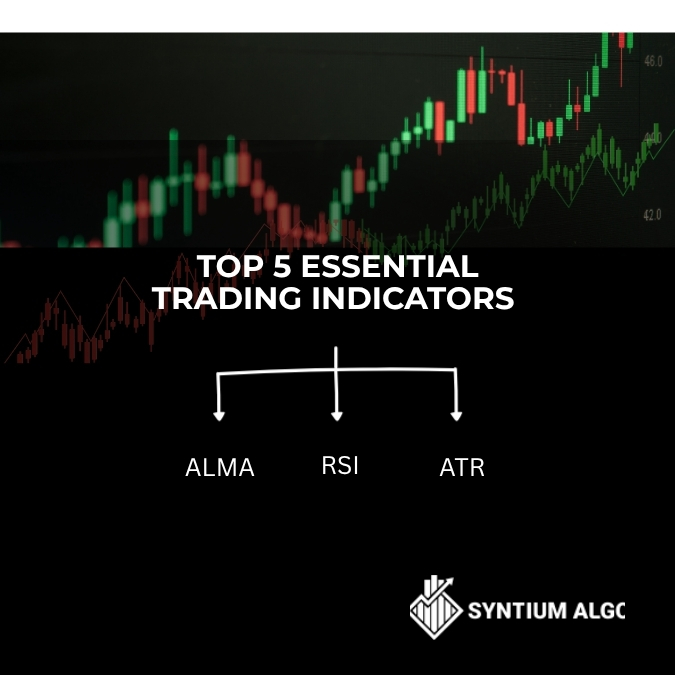
The trading landscape has evolved. In 2026, the markets move faster than ever, driven by high-frequency algorithms and real-time news cycles. To survive, you don’t need more tools; you need the right ones. Relying on outdated settings will only lead to “lag” and missed opportunities. Instead, successful traders are focusing on essential trading indicators that offer clarity amidst the noise.
Whether you are a day trader or a long-term investor, these five tools are non-negotiable for a professional setup.
1. The ALMA (Arnaud Legoux Moving Average)
Standard moving averages often suffer from a “lag vs. smoothness” trade-off. If it’s too fast, it’s noisy; if it’s too slow, you miss the entry. In 2026, the ALMA has become one of the most essential trading indicators because it solves this problem.
Using Gaussian distribution, the ALMA provides a smoother line that follows price closely without the erratic jumps of an EMA. Consequently, it allows you to identify the true trend direction while filtering out minor market “hiccups.”
2. Relative Strength Index (RSI) with Divergence Focus
The RSI is a classic, but in today’s market, we don’t just look at “overbought” or “oversold” levels. Modern traders use it to spot divergences. When the price makes a higher high, but the RSI makes a lower high, it signals that the trend is losing steam.
This makes it one of the most essential trading indicators for reversal traders. By combining RSI with AI-driven volume filters, you can predict market turns before they happen.
3. Volume Profile (Visible Range)
Price is only half the story; volume is the “conviction” behind the move. Unlike standard volume bars at the bottom of your chart, the Volume Profile shows you at what price the most trading occurred.
This tool identifies “High Volume Nodes,” which act as powerful support and resistance levels. Because big institutions trade at these levels, the Volume Profile is one of the truly essential trading indicators for understanding where “smart money” is positioned.
4. Average True Range (ATR) for Dynamic Risk
In 2026, fixed stop-losses are a recipe for disaster. Volatility changes every hour. The ATR measures market volatility and tells you how much a pair moves on average.
Therefore, it is one of the most essential trading indicators for risk management. By setting your stop-loss based on a multiple of the ATR, you give your trade enough “room to breathe” without taking unnecessary risks during high-volatility events.
5. Bollinger Bands (Standard Deviation Channels)
Bollinger Bands help you visualize market “squeeze” and “expansion.” When the bands tighten, a massive breakout is usually coming. In 2026, traders use these bands to catch “volatility breakouts.“
As an essential trading indicators staple, they help you stay out of sideways markets and only enter when the momentum is high. Furthermore, they are excellent for identifying when a price has moved too far, too fast, signaling a potential mean reversion.
Quality Over Quantity
Your chart should not look like a bowl of spaghetti. Using too many tools leads to “analysis paralysis.” Instead, pick two or three of these essential trading indicators that complement each other.
Combine a trend tool (ALMA) with a momentum tool (RSI) and a risk tool (ATR). This “Hybrid” approach, pairing complex math with human intuition, is exactly how the most profitable traders are winning in 2026 – using Syntium Algo.
FAQs
1. What is the best combination of indicators?
A classic “Triple Threat” setup involves the ALMA for trend, RSI for momentum, and Volume Profile for key price levels.
2. Do indicators work on all timeframes?
Yes, but they are most reliable on higher timeframes (1H, 4H, Daily). Low timeframes often contain too much “noise” for standard mathematical models.
3. Why is the “lag” in indicators a problem?
Lag means the indicator tells you what happened, not what is happening. Using modern tools like the ALMA helps reduce this delay, giving you a faster entry.
4. Can I use these indicators for Crypto and Forex?
Absolutely. These essential trading indicators are based on price action and volume, which are universal truths in any liquid financial market.
5. Is it better to use AI indicators or standard ones?
In 2026, the best indicators are “AI-Enhanced,” meaning they use standard math but apply machine learning filters to remove false signals.