Disclaimer: Syntium Algo and all affiliated parties are not registered as financial advisors. The information provided on this site, along with the products and services offered by Syntium Algo, are intended for educational purposes only and should not be interpreted as financial advice. It is important to understand the risks involved in trading and be willing to accept any level of risk when investing in financial markets. Please note that past performance is not necessarily indicative of future results. Syntium Algo and all individuals associated with the company has no responsibility for your trading results or invest decisions. It is recommended to conduct through research, seek professional advice, and carefully consider your financial situation before making any trading or investment decisions.
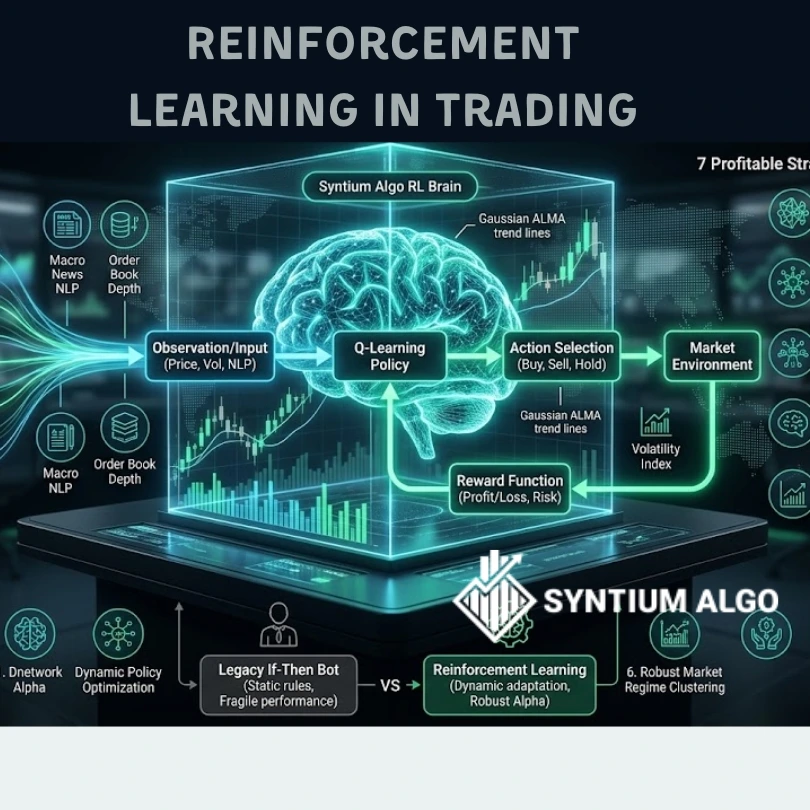
To navigate the volatility and generate consistent, risk-adjusted alpha, sophisticated quant desks and proprietary trading firms have shifted their cognitive framework. They have moved beyond standard supervised machine learning, which merely predicts the next price move based on history. Instead, they are embracing the ultimate evolution of systematic intelligence: Reinforcement Learning in Trading.
At Syntium Algo, we recognize this paradigm shift. We have engineered our latest algorithmic architectures not to forecast certainty, but to master statistical probability through autonomous experience. Reinforcement Learning (RL) is not just a tool; it is the foundational mechanism for building intelligent, adaptive trading agents that learn, adapt, and profit across all market regimes. This post is a masterclass in how this technology functions and the profitable strategies it unlocks.
The Cognitive Leap: Supervised ML vs. Reinforcement Learning
To grasp the power of Reinforcement Learning in Trading, we must first define its core differentiator. Standard AI in finance typically relies on supervised learning. In this model, you feed the AI millions of “labeled” historical charts. You are telling the model: “When X, Y, and Z conditions are met, the label is Buy.” The model learns the pattern and tries to classify unseen data into that Buy category.
The limitations of this approach in finance are severe:
- Financial Data is Not Static: A chart pattern in a low-volatility, low-rate environment looks nothing like the same pattern during a stagflationary crash. Supervised models require extensive retraining as data drifts.
- Prediction $\neq$ Profitability: A model can be 70% accurate at predicting the next candle’s direction (classification), but it might fail completely at trade execution (risk management, transaction costs, optimal hold time).
What is Reinforcement Learning (RL)?
Reinforcement Learning flips the script. Instead of learning by being told “what the label is,” the AI learns by doing. It is analogous to training a puppy through positive and negative reinforcement, or how a human learns a complex video game.
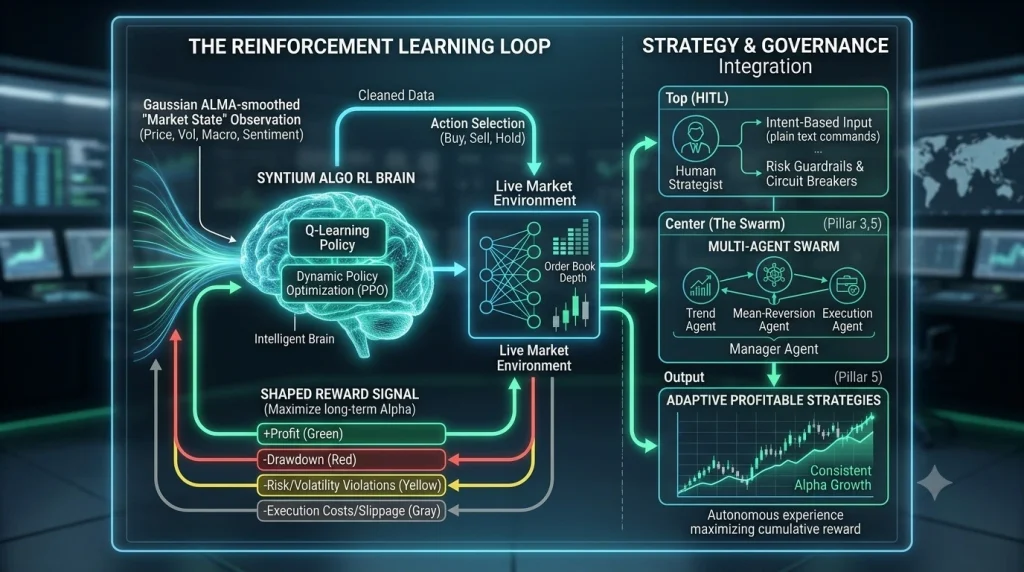
The RL architecture consists of a dynamic, repeating loop with four key components:
- The Agent (Syntium Algo): The intelligent system that is making decisions (the brain).
- The Environment (The Live Market): The context the agent is operating in (all order book data, volatile candlestick flows, sentiment streams).
- Actions: The choices available to the agent: Buy, Sell, or Hold.
- The Reward Signal (P&L and Risk): The feedback the agent receives for its actions. If an action results in profit within risk guardrails, the reward is positive. If an action results in an uncontrolled drawdown, the reward is heavily negative.
The objective of the Syntium Algo RL Brain is not to maximize accuracy. Its primary directive is to maximize its long-term cumulative reward. Over millions of iterations (epochs), the agent develops an internal “Policy”—a complex strategy that dictates the optimal action to take in any possible market state.
7 Pillars of Profitable Strategy: Reinforcement Learning in Trading
When applying Reinforcement Learning in Trading, we move beyond simple indicator strategies and into high-dimensional policy optimization. Here are seven distinct strategy pillars that RL unlocks:
Pillar 1: Deep Q-Network (DQN) for Alpha Generation
This is the classic foundation of deep RL. We combine Q-Learning (which estimates the value, Q, of taking a specific action in a specific state) with a deep neural network. The DQN scans multi-factor inputs (e.g., smoothed ALMA price slope, relative volatility, key central bank rate differentials). Instead of looking for a static crossover, the agent learns which states provide the highest probability of future cumulative profit.
A Syntium DQN agent might learn that during a specific quiet overnight sessionHAND, the highest-value action (Buy) occurs when price is below a specific volume-weighted support but institutional sentiment remains neutral. This is not a fixed rule; it is a learned state dependency.
Pillar 2: Dynamic Policy Optimization (PPO)
While DQN estimates action value, Policy Optimization (like Proximal Policy Optimization, or PPO) directly modifies the policy itself. PPO agents are highly stable and ideal for volatile regimes, such as the 2026 JPY carry trade unwind.
These agents are designed to navigate complex landscapes where minor parameter tweaks (like slightly loosening a stop-loss during a news spike) can radically alter long-term cumulative rewards. The Syntium PPO agent learns to dynamically adapt its trade management—widening or tightening stops, trailing profits, and scaling into positions based entirely on its real-time assessment of market state volatility, completely ignoring static indicators.
Pillar 3: Multi-Agent Swarms
In 2026, you cannot rely on a single agent. Reinforcement Learning in Trading thrives on modular, multi-agent architectures, often called “swarms.” Within the Syntium ecosystem, we deploy a swarm of specialized RL agents:
- The Trend Agent: Optimized via PPO for high-volatility regime trends.
- The Mean-Reversion Agent: Optimized via DQN for low-volatility consolidation brackets.
- The Execution Agent: Learns optimal order routing and timing (e.g., TWAP or VWAP optimization) to minimize market impact and slippage, maximizing the final reward signal.
A master “Manager Agent” coordinates the swarm, learning when to allocate capital to the Trend agent and when the market regime requires the Mean-Reversion agent.
Pillar 4: Natural Language Processing (NLP) and Sentiment Integration
RL is not limited to processing numerical data. Modern Syntium Algo RL Brain agents incorporate transformer models (NLP) to scan thousands of live news headlines and social sentiment streams simultaneously.
Instead of outputting a simple “Bullish” score, the agent integrates this sentiment vector into its overall market state observation. If a central bank release scans as “hawkish,” the agent’s confidence score for Short actions on affected pairs instantly increases, overriding pure technical configurations.
Pillar 5: High-Frequency/Statistical Arbitrage and Market Making
For high-frequency strategies (HFT), RL is a necessity. The markets move too fast for human-coded logic. RL agents learn to make millions of microscopic decisions to exploit fleeting statistical mispricings between highly correlated pairs, indices, and derivatives.
They learn to ‘read the tape’ of the order book, managing extreme position volatility while maximizing the reward signal from rebate capture and spread exploitation. Our RL agents minimize “Tool-Call Latency” to ensure execution happens before the opportunity evaporates.
Pillar 6: Robust Market Regime Clustering
RL can be unsupervised as well as reinforced. RL agents can be used to cluster current market data (price volatility, volume profile, correlation structures) into distinct, mathematically-defined “regimes.”
Once these regimes (e.g., high-volatility choppy, low-volatility bullish trend, crash matrix) are identified, the agent can activate the specific learned policy that maximizes cumulative reward for that exact environment. We are no longer “guessing” if we are in a trend; we are calculating the regime probability and adapting the strategy accordingly.
Pillar 7: Risk-Aware Reward Shaping and Drawdown Control
This is the single most critical differentiator of true institutional-grade Reinforcement Learning in Trading. We do not use a simple “Profit = Positive Reward, Loss = Negative Reward” system. We utilize “Reward Shaping.”
Our reward function incorporates complex risk metrics. An action that results in profit but violates strict volatility-adjusted invalidation brackets will receive a neutral or even negative reward signal. The agent must learn to find strategies that are not just profitable, but profitably consistent. It must learn that extreme risk exposure during low-liquidity session handovers results in an catastrophic negative reward, forcing it to develop robust daily drawdown management and circuit-breaker policies straight in its cognitive core.
The Syntium Advantage: Gaussian Smoothing, Human Guidance, and Cloud Intelligence
At Syntium Algo, we have refined Reinforcement Learning in Trading into a scalable, accessible product. We utilize the power, as the foundational architectural diagram for our systematic integration:
Gaussian Smoothing (ALMA Indicators)
We understand that noisy data confuses RL agents. We utilize Gaussian smoothing (Arnaud Legoux Moving Average, or ALMA) to provide the RL brain with the cleanest possible “state” observation. By filtering out high-frequency volatility jitters, we ensure the agent receives signals that stay tight to the true price action without being reactive to minor algorithmic noise. This increases the agent’s confidence scoring, leading to higher-quality entries and fewer stop-outs.
Human-in-the-Loop (HITL) Validation
Even the most advanced AI requires guardrails. Our system is built on Human-in-the-Loop (HITL) governance. The human provides the strategic intent, the intent-based inputs (e.g., plain English commands for strategy), and defines the overall risk guardrails and daily drawdown limits. The AI handles the autonomous execution and monitoring, ensuring machine discipline is maintained 24/7, freeing you from chart fatigue.
Cloud-Based Intelligence and Transparency
You do not need powerful hardware. Syntium Algo runs its intensive Reinforcement Learning in Trading models entirely in the cloud, minimzing Tool-Call Latency and ensuring real-time results are delivered through transparent, audited performance dashboards. Stop guessing and start calculating.
Join the AI-Powered Trading Swarm
The era of the “lone trader” battling the markets manually is ending. To compete in 2026, you need the technology and discipline used by institutional giants. Reinforcement Learning in Trading is the leveler of the playing field. It grants you the speed of a machine, the reasoning of an analyst, and the experience of millions of simulated sessions.
Syntium Algo provides the foundational engine for this new paradigm. Join the thousands of traders who have already made the switch from guessing to calculating. Stop relying on fragile, obsolete bots and start deploying the ultimate evolution of systematic intelligence. Welcome to the future of wealth-building with a smart, adaptive digital partner.
FAQs
What is the minimum balance required to use Syntium’s Reinforcement Learning systems?
Our RL agents are accessible through tiered packages designed for various capital sizes.
How long does it take for a Syntium RL agent to learn a profitable policy?
Syntium agents train in simulated environments, equivalent to centuries of real-time trading, before ever going live.
Does Syntium Algo support Reinforcement Learning in Trading on mobile devices?
Yes, our simplified user interface allows you to monitor and manage your agents from any device.
How does Syntium Algo manage transaction costs within the RL reward signal?
We heavily integrate exchange fees, swap costs, and dynamic slippage estimates directly into the agent’s reward function.
Can I use plain English to instruct the Syntium RL agents?
Yes, our intent-based platform translates natural language instructions into functional agent parameters instantly.
Are the Reinforcement Learning models on Syntium cloud-based or local?
All intensive RL model execution and monitoring run entirely on Syntium’s high-speed enterprise servers.
How does human feedback influence the Syntium Reinforcement Learning agents?
Humans define the strategic guardrails and intent, which the agent then executes autonomously with discipline.