Disclaimer: Syntium Algo and all affiliated parties are not registered as financial advisors. The information provided on this site, along with the products and services offered by Syntium Algo, are intended for educational purposes only and should not be interpreted as financial advice. It is important to understand the risks involved in trading and be willing to accept any level of risk when investing in financial markets. Please note that past performance is not necessarily indicative of future results. Syntium Algo and all individuals associated with the company has no responsibility for your trading results or invest decisions. It is recommended to conduct through research, seek professional advice, and carefully consider your financial situation before making any trading or investment decisions.
Deploying multi agent llm trading networks represents the modern frontier for quantitative hedge funds and systematic asset managers striving for consistent alpha in complex markets. You prompt a standalone Large Language Model (LLM) to evaluate a portfolio thesis, and it initially delivers impressive analytical depth. However, unexpected news shocks or conflicting market signals quickly cause the single model to hallucinate key facts or stick to a flawed bias. The core problem is that single-model architectures lack internal checks and balances. Relying on a solitary AI agent to process news, generate entry signals, and manage position risk forces one network to handle competing priorities simultaneously. This single-point-of-failure approach exposes your capital to unvetted logic, model drift, and sudden drawdowns.
Fortunately, modern financial technology solves this challenge through agentic swarm intelligence. Instead of trusting one model with every task, quantitative teams deploy collaborative, multi-agent networks. Specialized LLM agents work together in a structured pipeline. They analyze raw market data, debate opposing trade theses, and submit proposals to hardcoded risk checkers.
Syntium Algo empowers you to harness this evolution. Deploy our advanced agentic AI platform today to move beyond single-model limitations and master market volatility with intelligent, collaborative automation.
The Problem with Single-Model Alpha Engines
To build resilient automated trading systems, quantitative developers must understand why single-LLM setups underperform. Single-model configurations attempt to ingest unstructured text, calculate technical indicators, evaluate risk, and submit order payloads all within a single prompt cycle. This broad focus introduces structural vulnerabilities that undermine live execution performance.
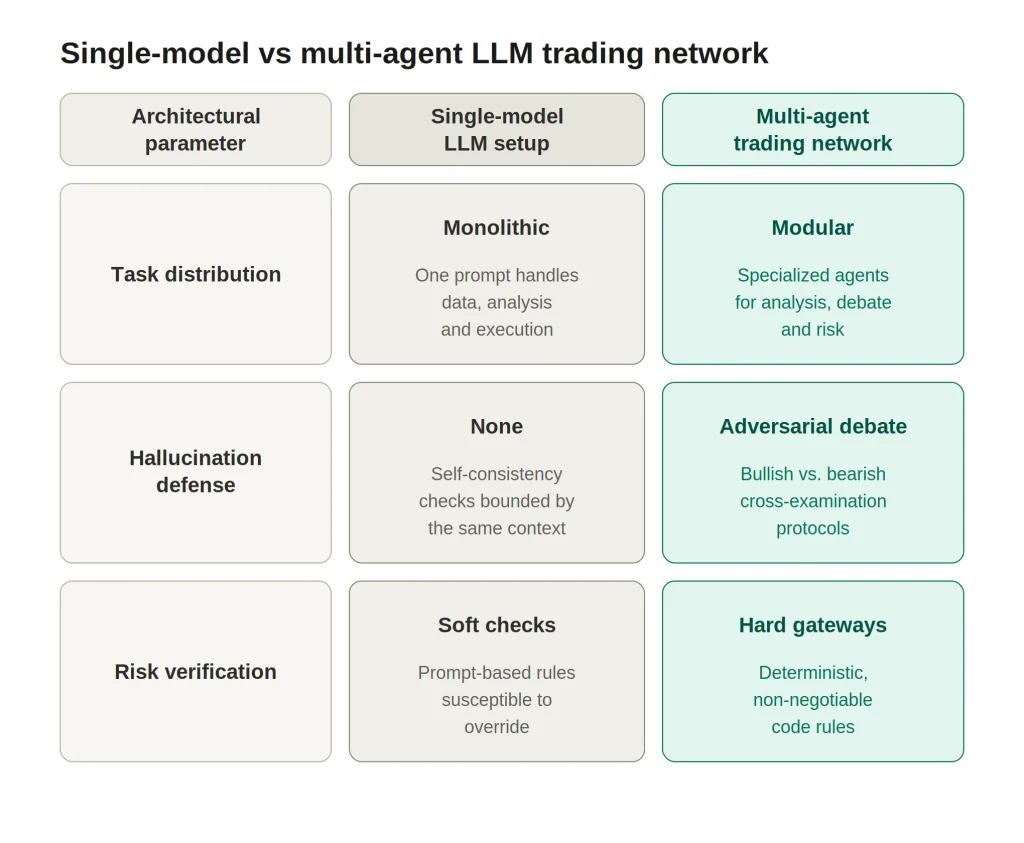
Primary operational failure points in single-model trading architectures include:
- Contextual Hallucination: A single LLM processing dense financial reports can invent inaccurate metrics or mistake historical data for live conditions.
- Cognitive Bias Inertia: Once a single model forms a bullish or bearish stance, it often interprets subsequent counter-evidence incorrectly.
- Overconfidence in Edge Cases: Isolated LLMs lack an internal opposition mechanism to challenge high-risk trade setups during low-liquidity events.
- Task Overload Decay: Combining complex macro data parsing with low-latency order generation degrades both reasoning accuracy and execution speed.
Deconstructing the Swarm Architecture: Specialized Agent Roles
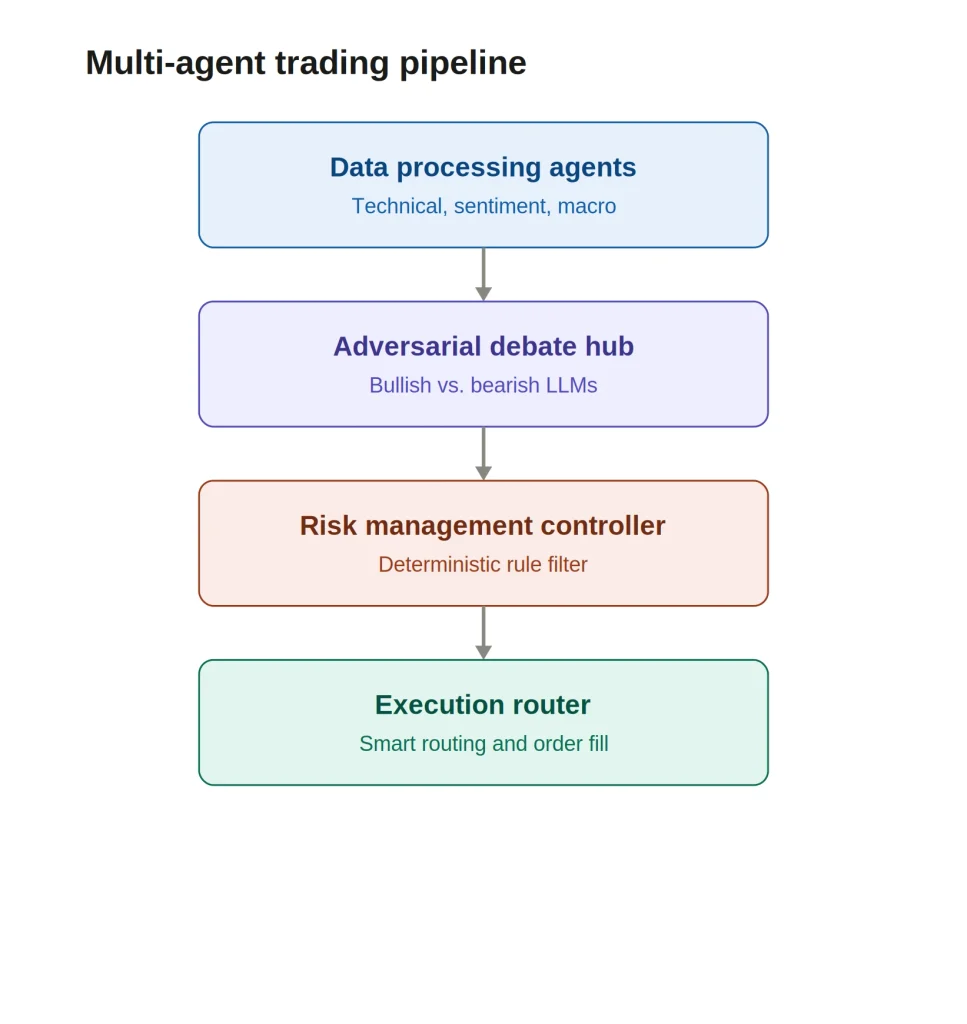
Deploying multi agent llm trading networks requires dividing complex quantitative tasks into modular, role-specific agents. Each agent focuses exclusively on a single domain. Consequently, the system operates like an institutional trading desk, where specialized team members collaborate to refine ideas before risking real capital.
1. Data Ingestion & Analytics Agents
The primary layer consists of specialized analysts. A Technical Analyst Agent computes moving average crossovers, Relative Strength Index (RSI) levels, and order book depth. Simultaneously, a Sentiment Analyst Agent scans social streams, central bank releases, and earnings transcripts using Natural Language Processing (NLP). A Macro Economist Agent tracks yield curves, inflation metrics, and cross-asset correlations.
2. The Adversarial Research Team
Insights from the analyst layer feed directly into opposing researcher agents. A Bullish Researcher Agent evaluates data to build the strongest possible long thesis. Concurrently, a Bearish Researcher Agent searches for hidden risks, potential bull traps, or macro headwinds.
3. The Portfolio & Risk Controller
The Risk Control Agent reviews proposed strategies against strict portfolio parameters. It evaluates volatility surfaces, liquidity depth, and maximum allowable drawdowns. If a trade exceeds risk boundaries, this agent vetoes or resizes the order proposal instantly.
The Power of Adversarial Debate Protocols
The core advantage of deploying multi agent llm trading networks lies in their consensus and debate mechanisms. Rather than accepting an initial buy or sell signal, the network initiates a structured argument. This multi-agent debate forces opposing models to justify their positions using verifiable market data.
Debate protocols systematically filter out weak alpha signals through strict, multi-stage iterations:
- Thesis Presentation: The Bullish Agent presents entry targets, stop-loss levels, and growth rationale.
- Cross-Examination: The Bearish Agent challenges the thesis by pointing out conflicting indicators, like declining volume or high-timeframe resistance.
- Rebuttal & Parameter Adjustment: The Bullish Agent must address those counter-arguments by refining order sizes or tightening stop distances.
- Consensus Scoring: A neutral Synthesizer Agent calculates a consensus conviction score based on argument strength.
By requiring models to defend their logic, consensus networks neutralize individual model hallucinations. Weak signals get discarded during debate, ensuring only high-conviction strategies reach the order execution queue.
Bridging Agentic Consensus with Deterministic Execution
While LLM agents excel at qualitative reasoning and sentiment analysis, they must never hold unrestricted authority over order placement. Live trading environments demand absolute execution precision, zero latency, and rigid risk containment.
Therefore, institutional-grade quantitative systems combine LLM consensus networks with hardcoded execution guardrails. Once the multi-agent network reaches a consensus conviction score above a defined threshold, it routes the proposed trade payload to a deterministic execution engine.
Essential deterministic guardrails include:
- Hard Daily Stop-Loss Limits: Non-negotiable code blocks that block all trading activity if daily portfolio drawdown reaches a set percentage.
- Real-Time Spread Checkers: Automated filters that pause order execution if exchange bid-ask spreads widen beyond historical norms.
- Position Concentration Caps: Deterministic rules restricting total exposure to a single asset class or sector, regardless of AI conviction levels.
- Slippage Protection Algorithms: Execution tools that split large consensus orders using TWAP (Time-Weighted Average Price) logic to minimize market impact.
How Syntium Algo Simplifies Multi-Agent Network Deployment
Designing custom multi agent llm trading networks from scratch typically requires managing complex API pipelines, orchestration frameworks, and low-latency exchange interfaces. Syntium Algo removes these technical barriers by providing a unified, institutional-grade infrastructure engineered for agentic quantitative trading.
Syntium Algo connects advanced multi-agent consensus logic directly with high-performance execution tools. As a result, quantitative developers and systematic traders can deploy collaborative AI swarms without writing thousands of lines of boilerplate code.
Key advantages of utilizing Syntium Algo for multi-agent trading include:
- Pre-Built Agent Templates: Access specialized analyst, debater, and risk manager LLM roles pre-configured for instant deployment.
- Low-Latency Consensus Routing: Execute multi-agent debates in milliseconds using optimized, parallel model processing architectures.
- Integrated Deterministic Risk Breakers: Protect your trading capital with hardcoded circuit breakers that automatically enforce risk rules.
- Multi-Asset Backtesting Suite: Test collaborative agent networks against historical tick data, simulating real-world market slippage and news shocks.
Step-by-Step Action Plan: Deploying Your First Swarm Network
Transitioning from single-indicator strategies to a multi-agent quantitative pipeline requires systematic testing and phased deployment.
Follow these practical steps to build and launch an agentic trading network safely:
1: Define Explicit Conviction Thresholds
Do not execute trades on simple binary outputs. Require your consensus network to generate a minimum 80% conviction score across all participating analyst agents before authorizing an entry payload.
2: Isolate the Risk Manager Agent
Ensure your Risk Management Agent runs on a separate, high-precision model instance. Program this agent with veto power over any trade proposal that violates portfolio volatility boundaries.
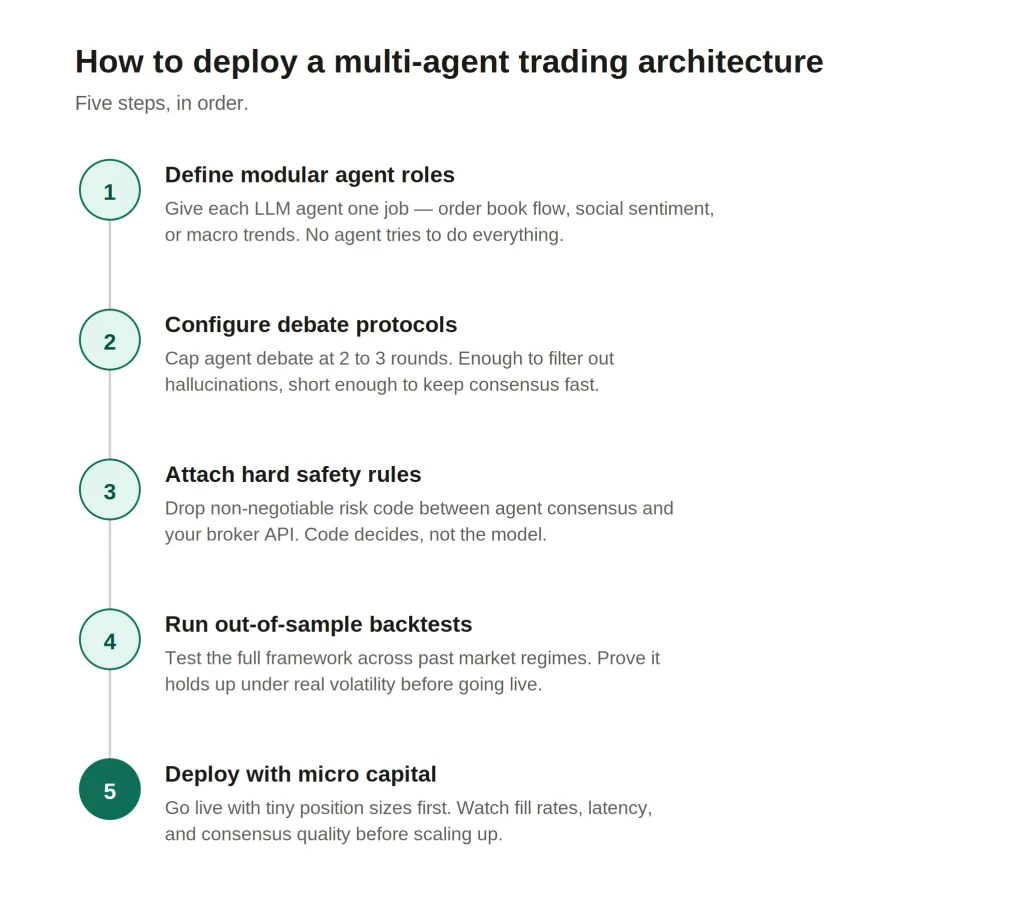
Use this execution sequence to deploy your multi-agent architecture successfully:
Build Next-Generation Multi-Agent Trading Swarms with Syntium Algo Today!
FAQs
What are multi agent LLM trading networks?
Multi agent LLM trading networks are quantitative frameworks where specialized AI models—such as analysts, researchers, debaters, and risk managers—collaborate and debate market data to execute systematic trades.
How do multi-agent debate protocols reduce trading risk?
Debate protocols force opposing bullish and bearish LLMs to cross-examine market data. This debate filters out contextual hallucinations and weak entry signals before trades reach execution.
Can multi-agent LLM networks execute live trades automatically?
Yes, but professional systems route multi-agent trade proposals through hardcoded deterministic risk rules to verify position sizes, drawdown limits, and slippage buffers before sending orders to an exchange.
The Best AI Trading Indicator on TradingView in 2026: Review
[…] traders rely on Syntium Algo. Syntium Algo bridges raw market feeds with machine learning and agentic consensus logic, delivering high-probability signals, transparent feature attributions, and dynamic risk controls […]