Disclaimer: Syntium Algo and all affiliated parties are not registered as financial advisors. The information provided on this site, along with the products and services offered by Syntium Algo, are intended for educational purposes only and should not be interpreted as financial advice. It is important to understand the risks involved in trading and be willing to accept any level of risk when investing in financial markets. Please note that past performance is not necessarily indicative of future results. Syntium Algo and all individuals associated with the company has no responsibility for your trading results or invest decisions. It is recommended to conduct through research, seek professional advice, and carefully consider your financial situation before making any trading or investment decisions.
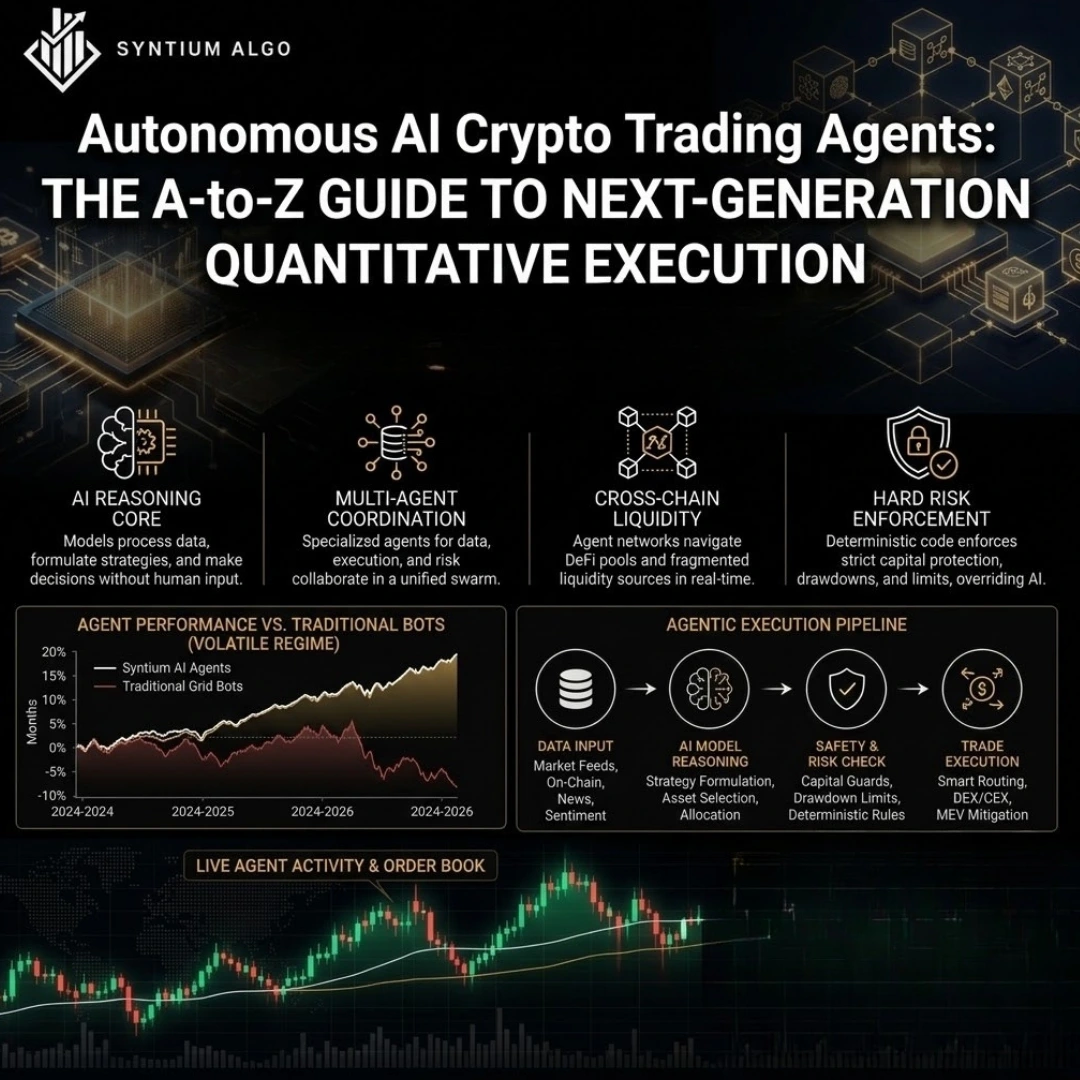
Navigating autonomous ai crypto trading agents has quickly become the primary focus for quantitative hedge funds, Web3 developers, and individual crypto traders. Who are Aiming to capture alpha across highly fragmented, 24/7 digital asset markets. You configure a standard grid bot or a Moving Average Crossover model with immense promise. Yet unexpected liquidity shifts, sudden mempool congestion, or high-frequency liquidation cascades repeatedly trigger stop-losses and destroy capital. The core issue is that conventional algorithmic trading software runs on static, if-then rules. When decentralized exchanges (DEXs), centralized exchanges (CEXs), and cross-chain bridges experience sudden regime shifts, these rigid scripts fail to adapt, resulting in high slippage, bad fills, and severe portfolio drawdowns.
Fortunately, the evolution of agentic artificial intelligence, combining Large Language Models (LLMs), machine learning, and dynamic tool-calling, provides an intelligent solution to crypto’s structural volatility. Unlike traditional trading bots that strictly wait for hardcoded price triggers, autonomous AI agents reason independently. Continuously parse multi-chain data, evaluate risk constraints, and execute non-predefined actions to achieve a designated objective. Syntium Algo empowers you to harness this evolution. Deploy our advanced agentic AI platform today to move beyond hardcoded limitations and master crypto’s volatility with intelligent, goal-oriented automation.
The Evolution: Traditional Trading Bots vs. Autonomous AI Agents
To leverage modern quantitative finance effectively, traders must differentiate between legacy algorithmic trading bots and truly autonomous AI trading agents. While the former executes deterministic rules, the latter operates as an adaptive digital entity capable of dynamic decision-making.
Traditional bots rely entirely on fixed parameters. If you program a bot to buy a token when its Relative Strength Index (RSI) drops below 30, it will execute the buy order regardless of market context. Even if an exploit just occurred on the protocol’s underlying smart contract. Conversely, an autonomous AI trading agent evaluates technical indicators alongside live news feeds, protocol TVL (Total Value Locked) changes, and developer wallet activity before authorizing a single order.
Goal-Oriented Reasoning Engine
Instead of following a rigid sequence of instructions, an autonomous agent is assigned an objective function, such as “Maximize risk-adjusted yields on stablecoin pairs while keeping drawdown under 4%.” The agent independently decides the best path to reach that goal.
Unstructured Data Ingestion
Modern trading agents parse natural language news, developer commits on GitHub, Telegram/X sentiment, and on-chain whale wallet alerts in real-time. Integrating unstructured data directly into their quantitative models.
Multi-Agent Coordination Frameworks
Advanced implementations use specialized sub-agents. One sub-agent actively scans order books for liquidity depth, a second tracks macro sentiment, and a third enforces risk limits, working together to execute optimized trades.
Anatomy of an Autonomous AI Trading Agent: The 4-Layer Stack
Building or deploying autonomous ai crypto trading agents requires a multi-layered software architecture capable of processing data at low latency while applying complex cognitive reasoning.
Understanding these four layers reveals how an agent transforms raw crypto market noise into profitable, risk-managed execution:
- Observation Layer (Data Pipeline): Ingests real-time CEX order book snapshots, DEX liquidity pool balances, mempool transaction streams, and sentiment metrics.
- Reasoning Layer (LLM & ML Core): Processes incoming observations, evaluates alternative scenarios using trained machine learning models, and selects an optimal trade strategy.
- Planning & Memory Layer: Maintains short-term operational memory (e.g., active order states) and long-term memory (historical performance patterns) to refine future decisions.
- Execution & Safety Layer: Connects to centralized exchange APIs or directly broadcasts signed transactions to blockchain networks via smart contract wallets.
The Role of LLMs in Strategy Formulation
Large Language Models act as the strategy orchestrator. By interpreting broad macro environments and high-level news, the LLM sets short-term directional bias, passing execution parameters down to ultra-fast machine learning sub-models.
On-Chain Smart Contract Execution
For decentralized finance (DeFi), agents interact directly with liquidity pools, automated market makers (AMMs), and lending protocols. The execution layer handles gas estimation, slippage tolerance, and MEV (Maximal Extractable Value) protection to prevent front-running.
Real-Time Liquidity Routing and Cross-Chain Execution
Liquidity in the cryptocurrency market is highly fragmented across dozens of Layer-1 blockchains, Layer-2 scaling solutions, and centralized order books. A strategy that works seamlessly on an Ethereum L2 may suffer heavy slippage on a Solana or Avalanche DEX if liquidity thins out.
Autonomous trading agents address this fragmentation through intelligent cross-chain routing. By scanning pool depths across multiple chains simultaneously, an agent calculates whether to split an order across three distinct DEXs or execute it through a centralized order book via a secure API bridge.
Preventing Slippage with Smart Order Splitting
Large orders often move thin crypto markets. Autonomous agents split large buy or sell orders into dynamic sub-orders using Time-Weighted Average Price (TWAP) or Volume-Weighted Average Price (VWAP) algorithms, masking institutional intent.
Navigating On-Chain MEV and Sandwich Attacks
When trading directly on-chain, public mempools leave orders vulnerable to toxic MEV bots. Advanced AI execution layers route transactions through private RPC endpoints (such as Flashbots), hiding trade intent until block inclusion.
Advanced Risk Management in Agentic Trading
While autonomous ai crypto trading agents offer unprecedented operational speed, giving software direct execution authority over capital requires strict, unbreakable risk guardrails.
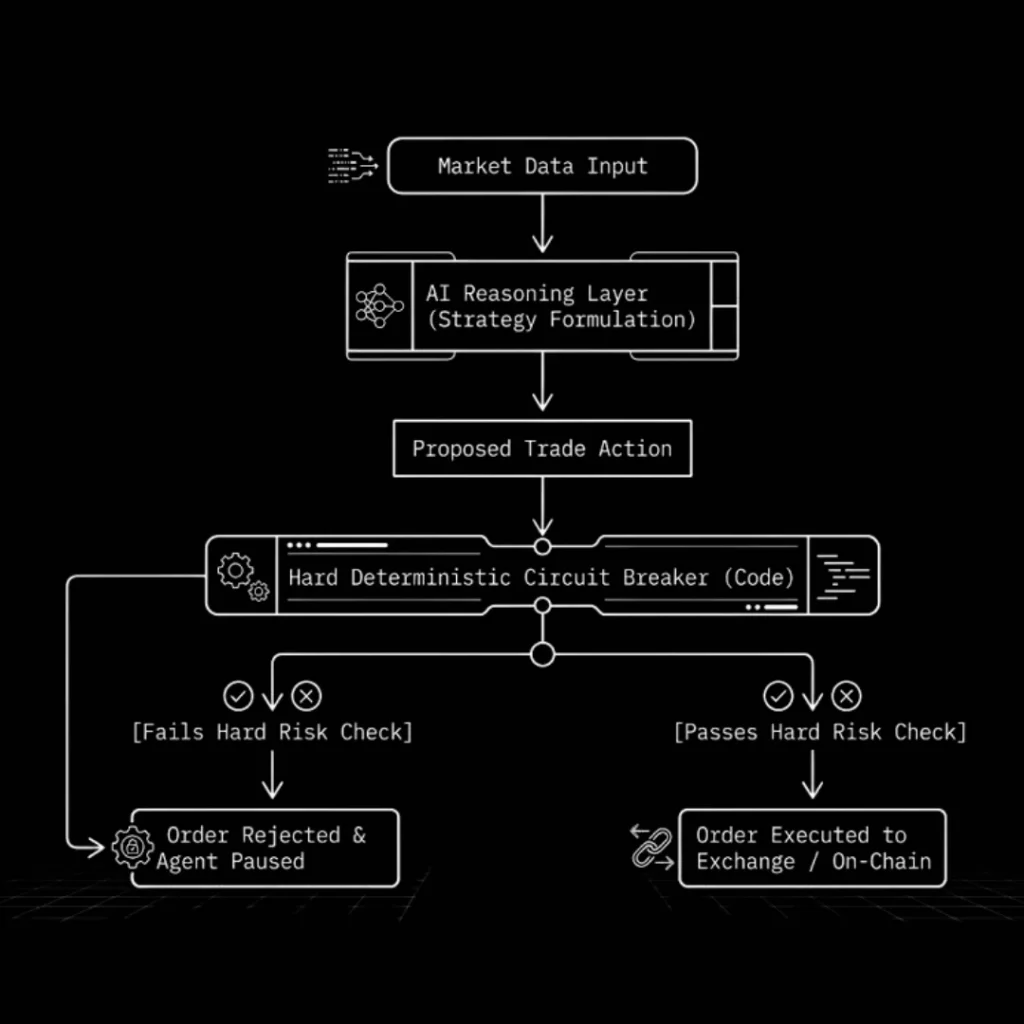
Without hard risk boundaries, an AI agent could hallucinate under extreme, unseen market conditions and continuously buy a depreciating asset. Institutional agentic frameworks solve this problem by implementing a dual-layer risk system: soft risk checks managed by the AI, and hard risk limits enforced by deterministic code.
Deterministic Hard Circuit Breakers
A hard circuit breaker is non-negotiable code that sits between the AI reasoning engine and the exchange API. If the AI attempts to place an order that exceeds a maximum portfolio loss limit (e.g., 2% per trade or 5% daily drawdown), the circuit breaker rejects the transaction instantly.
Volatility-Adjusted Position Sizing
Rather than relying on fixed dollar amounts, autonomous agents dynamically adjust trade allocation based on real-time market volatility. When market volatility spikes, the agent automatically scales down position sizes to keep total portfolio risk constant.
How Syntium Algo Powers Next-Gen Autonomous AI Trading
Deploying custom autonomous AI agents from scratch usually requires dedicated teams of quantitative developers, machine learning engineers, and Web3 infrastructure specialists. Syntium Algo eliminates these technical barriers by offering an all-in-one quantitative execution platform engineered for the agentic crypto era.
Syntium Algo bridges the gap between complex multi-agent reasoning and seamless market execution. Its low-latency infrastructure enables individual traders and institutional quantitative funds to build, backtest, and deploy risk-managed AI trading strategies across both centralized exchanges and decentralized protocols.
Integrated Sentiment and On-Chain Telemetry
Syntium Algo feeds live multi-chain data, exchange order book dynamics, and natural language sentiment directly into your strategy layer, giving your trading bots real-time situational awareness.
Fail-Safe Execution Guardrails
The platform features built-in, hardcoded risk modules. That automatically protect capital during liquidity drops, sudden spread expansion, or exchange API downtime.
No-Code to Low-Code Agent Deployment
Traders can easily construct dynamic AI strategies through an intuitive interface. Test your algorithms against years of historical crypto tick data, including black swan liquidation events, before committing live capital.
Step-by-Step Execution Plan: Deploying Your First AI Agent
Transitioning from theoretical strategy concepts to live automated execution demands a disciplined, step-by-step workflow.
Follow these concrete implementation steps to ensure system stability and capital safety:
Define an explicit operational edge
Never prompt an agent with vague instructions like “Trade profitable altcoins.” Instead, define an explicit, testable parameter set: “Monitor top-50 DEX pools for TVL surges exceeding 15% in 1 hour with positive sentiment scores, and capture short-term momentum using a 1.5% trailing stop.”
Require dynamic multi-timeframe validation
Program your strategy to validate low-timeframe trade signals (5-minute charts) against macro market trends (4-hour or daily timeframes) before submitting execution orders, drastically cutting down false breakouts.
Incorporate these proven execution guidelines into your deployment roadmap:
- Audit Historical Tick Data Backtests: Test your agent’s decision logic against severe historical market crashes to verify that capital protections perform correctly under pressure.
- Enforce Extended Paper Trading: Run live simulated paper trading for a minimum of 14 continuous days to log agent decisions across both calm and volatile sessions.
- Start with Minimum Viable Live Capital: Deploy live strategies using minimal position sizes to confirm that fill rates, API latency, and real-world execution match your backtested models.
- Monitor Strategy Performance: Continuously track execution metrics to detect model drift or alpha decay, adjusting underlying ML features as market dynamics evolve.
FAQs
What are autonomous AI crypto trading agents?
Autonomous AI crypto trading agents are software entities that use machine learning, LLMs, and automated tool-calling to evaluate market data, make independent trading decisions, and execute trades across CEXs and DEXs. without needing human confirmation for each action.
How do AI trading agents differ from traditional crypto trading bots?
Traditional trading bots follow strict, hardcoded “if-then” rules. Autonomous AI agents are goal-oriented, analyzing real-time technical indicators, news sentiment, and on-chain liquidity. to adapt their strategy as market conditions change.
How do autonomous AI agents protect trading capital from hallucinations or losses?
Professional frameworks use deterministic hard circuit breakers. Code that enforces strict position limits, max drawdown thresholds, and stop-loss rules that the AI engine cannot override.
Best Crypto Trading Signals in 2026: How to Pick Real Ones (and Skip the Scams) - Syntium Algo
[…] why non-repainting logic and signal filtering matter so much. If you want to go deeper, read about autonomous AI crypto trading agents and where the technology is […]