Disclaimer: Syntium Algo and all affiliated parties are not registered as financial advisors. The information provided on this site, along with the products and services offered by Syntium Algo, are intended for educational purposes only and should not be interpreted as financial advice. It is important to understand the risks involved in trading and be willing to accept any level of risk when investing in financial markets. Please note that past performance is not necessarily indicative of future results. Syntium Algo and all individuals associated with the company has no responsibility for your trading results or invest decisions. It is recommended to conduct through research, seek professional advice, and carefully consider your financial situation before making any trading or investment decisions.
Type best crypto trading signals into Google and you will find hundreds of Telegram groups promising 90% win rates. Most of them can’t prove a single trade. Some are scams built to take your money before you notice.
So how do you find signals that actually help? You stop looking at promises and start checking proof. This guide shows you what good crypto signals look like, how free and paid options compare, the red flags that expose fake providers, and which tools are worth testing in 2026.
No hype. Just a clear way to choose.
What Are Crypto Trading Signals?
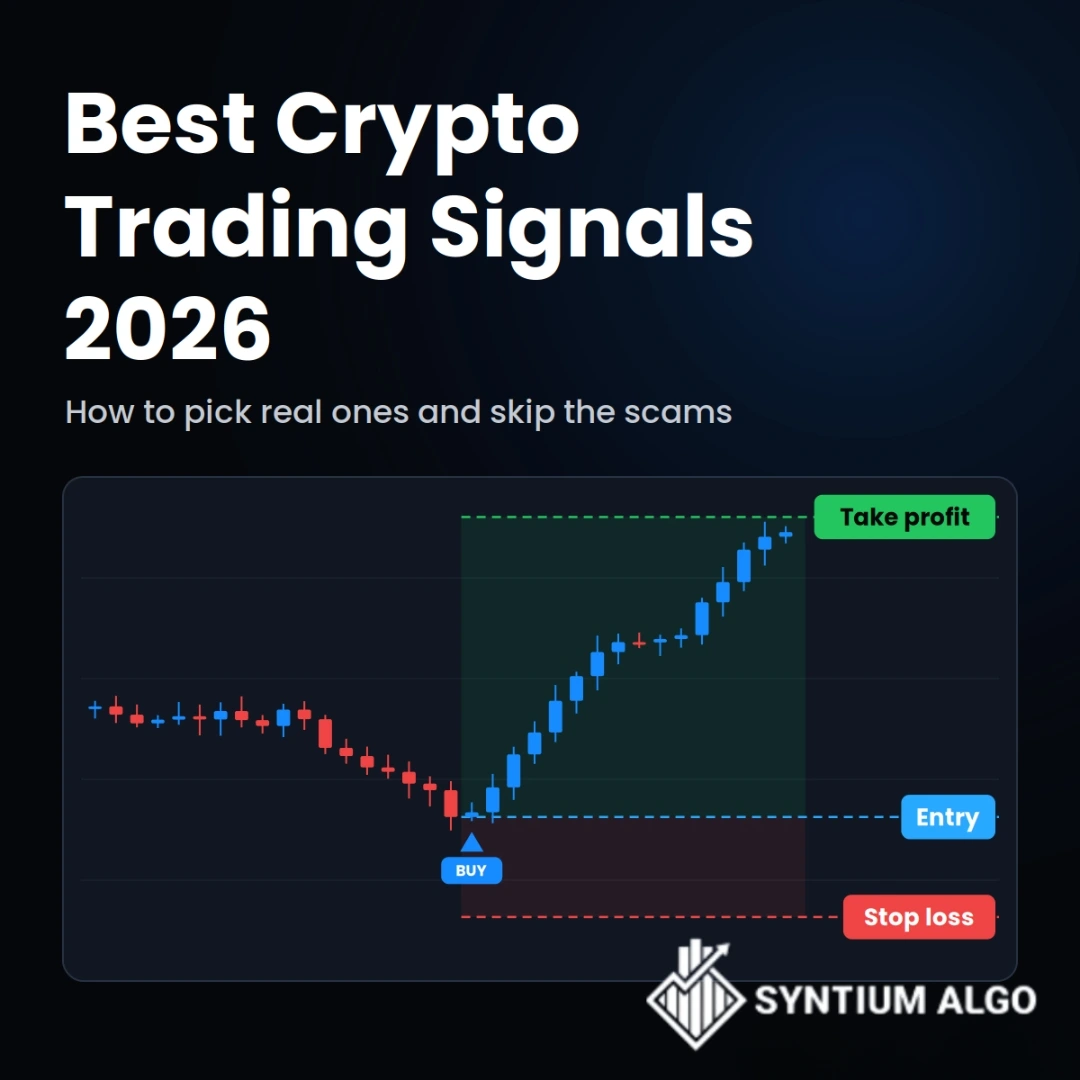
A crypto trading signal is a trade idea with clear instructions. It tells you which coin to trade, which direction to take, where to enter, and where to exit. Signals come from human analysts, technical indicators, or AI models.
A good signal never leaves you guessing. It should look something like this:
Direction: LONG (BUY)
Entry zone: 61,200 to 61,800
Stop loss: 59,900
Take profit 1: 63,500 | Take profit 2: 65,200
Risk: 1% of account | Reason: trend continuation after pullback
See the stop loss? That line matters more than any other. A signal with no stop loss is not a signal. It is a gamble with someone else’s opinion attached.
The 4 Main Types of Crypto Signals
Not all crypto signals work the same way. Before you compare providers, know which type you are buying.
1. Manual analyst signals
A human trader studies the charts and posts trades in a Telegram or Discord group. Quality depends entirely on that person. Some are skilled. Many are not, and you rarely get to see their full history.
2. Indicator-based signals
These come from technical indicators running on platforms like TradingView. The indicator prints buy and sell markers on your chart based on fixed rules. You see the signal form in real time, on your own screen.
3. AI and algorithmic signals
These use models that read price, volume, and momentum data across many markets at once. Good ones filter out weak setups before they reach you. If you want to see how that filtering works, our guide on meta-labeling for trading signals breaks it down.
4. Copy trading
Instead of reading signals, you mirror another trader’s positions automatically. Many large exchanges offer this. It saves time, but you hand over a lot of control. Read our copy trading system guide before you try it.
Free vs Paid Crypto Signals
Free sounds great. But free signal groups need to make money somehow. Usually that means pushing you toward a paid VIP tier, an exchange referral link, or a pump scheme where early members sell to late ones.
That doesn’t mean every free signal is bad. Free TradingView community indicators and free community groups can be useful for learning. Just know what you’re getting.
| Feature | Free Signals | Paid Signals |
|---|---|---|
| Cost | Nothing upfront | Monthly or yearly subscription |
| Signal detail | Often just “Buy BTC now” | Usually full entry, stop loss, and targets |
| Track record | Rarely shared | Should be shared (if not, walk away) |
| Support | Little or none | Setup help and direct support |
| Hidden motive | Referral links, VIP upsells, pumps | The subscription itself |
| Best for | Learning and testing ideas | Traders who want a repeatable system |
The real question isn’t free vs paid. It’s this: can the provider show you how their signals are made and how they performed?
7 Things to Check Before You Trust Any Signal Provider
Use this checklist every time. It takes ten minutes and can save you months of losses.
- Full trade details. Every signal should include entry, stop loss, and take profit. If any of these are missing, skip the provider.
- Losing trades are shown. Every real trader loses. A results page with only winners is edited, not honest.
- Signals don’t repaint. Some indicators change past signals after the candle closes, which makes backtests look perfect. Learn how to spot this in our guide to non-repainting signals.
- Clear risk rules. Good providers tell you how much of your account to risk per trade. Bad ones tell you to “go big.”
- You can see the signal form. Signals you can watch on your own chart are easier to verify than screenshots posted after the fact.
- Real support. Send a question before you pay. A slow or vague answer tells you a lot.
- A clear refund and cancel policy. You should be able to leave easily. If cancelling is hard, that’s a warning sign.
Red Flags: How Crypto Signal Scams Work
This isn’t a small problem. In the FBI’s 2025 Internet Crime Report, published in April 2026, Americans reported more than $11.3 billion in crypto-related losses. Crypto investment fraud alone made up $7.2 billion, the single biggest loss category of the year. You can read the full data on the FBI IC3 website.
Signal scams usually follow the same pattern. Watch for these red flags:
- Guaranteed profits. No one can guarantee returns in crypto. Anyone who does is lying.
- Win rates of 90% or higher. Especially with no verified trade history behind them.
- “Send us your funds and we’ll trade for you.” Never send crypto to a signal provider’s wallet.
- Pressure to act fast. “Only 3 VIP spots left” is a sales trick, not a trading edge.
- Fake admins messaging you first. Real group admins rarely DM members with offers.
- Screenshots instead of records. Screenshots are easy to fake. Live chart signals are not.
- Pushing unknown low-cap coins. This is often a pump and dump. The group buys early and sells to you.
Best Crypto Trading Signal Options in 2026
There’s no single best provider for everyone. The right choice depends on how you trade, how much time you have, and how much control you want. Here’s an honest look at the main options.
| Option | Signal Type | Where It Runs | Free Option | Best For |
|---|---|---|---|---|
| Syntium Algo | AI indicator signals + VIP signal room | TradingView + Telegram | Free Telegram community | Traders who want AI signals on their own chart across crypto, forex, and more |
| LuxAlgo | Indicator toolkits + AI backtesting | TradingView | Large free indicator library | Traders who like building and testing their own strategies |
| Cornix | Automation tool (not a signal source) | Telegram, Discord, exchanges | Trial available | Traders who already follow a signal group and want trades executed automatically |
| Exchange copy trading | Mirror other traders | Inside major exchanges | Usually free to join | Hands-off traders who accept less control |
| Free TradingView scripts | Community indicators | TradingView | Yes | Beginners learning how signals are built |
Syntium Algo
Syntium Algo delivers AI-powered buy and sell signals directly on your TradingView chart through invite-only indicators. You see each signal form live, so there’s nothing to take on trust. It works across crypto, forex, stocks, futures, indices, and commodities, on any timeframe, with no coding needed.
- Access to all indicators, setups, and tools on every plan
- VIP signal room and VIP Telegram for live setups
- Auto or semi-auto modes
- 24/7 priority support and cancel anytime from your dashboard
- Plans start at $29.99 per month, with quarterly, yearly, and a 90-day bootcamp option (see pricing)
Want to test the waters first? Join the free Syntium Telegram community before you commit.
LuxAlgo
LuxAlgo is one of the biggest names on TradingView. A free account gives you access to a large library of free indicators, and paid plans add exclusive tools and AI-powered backtesting. Paid plans also come with a 30-day money-back guarantee on your first payment. It’s a strong pick if you enjoy building strategies yourself rather than following ready-made calls.
Cornix
Cornix doesn’t create signals. It’s an automation platform that reads signals from Telegram or Discord groups and places the trades on your exchange account. It supports major exchanges such as Binance, OKX, KuCoin, and Bybit. Remember the catch, though: automation only executes the signals you feed it. Bad signals, executed faster, are still bad signals.
Exchange copy trading
Most large exchanges now let you copy a lead trader’s positions with a few clicks. It’s easy to start. The downside is control. You trade whatever the lead trader trades, at whatever risk they choose. Always check their drawdown history, not just their total profit.
Free TradingView community scripts
TradingView has thousands of free community indicators. They’re great for learning how signals are built. Quality varies a lot, though, and some repaint. Test any free script on a demo account first.
AI Signals vs Manual Signals
Manual signals depend on one person’s judgement, mood, and schedule. AI signals follow the same rules every time, even at 3am when the market moves and the analyst is asleep.
| Factor | Manual Signals | AI Signals |
|---|---|---|
| Consistency | Changes with the analyst | Same rules every time |
| Speed | Minutes to hours | Real time on the chart |
| Markets covered | A few coins at once | Many markets and timeframes |
| Emotion | Fear and greed can creep in | No emotion in the logic |
| Weak spot | Human bias and fatigue | Needs good design to avoid overfitting |
AI isn’t magic, though. A badly built model can look brilliant in a backtest and fail live. That’s why non-repainting logic and signal filtering matter so much. If you want to go deeper, read about autonomous AI crypto trading agents and where the technology is heading.
How to Use Crypto Signals on TradingView Safely
Even the best crypto trading signals won’t save a trader who ignores risk. Follow these steps.
- Start on a demo account. Run any new signal source on paper first. Two to four weeks gives you a real feel for it.
- Risk 1% to 2% per trade. Losing streaks happen to every system. Small risk keeps you in the game. Our risk management guide explains how to size positions.
- Always set the stop loss. Place it the moment you enter. Not later.
- Set alerts so you don’t miss signals. You don’t need to stare at charts all day. Follow our guide on how to set alerts on TradingView.
- Keep a trade journal. Log every signal you take and every one you skip. After 30 trades, the numbers will tell you the truth.
- Go easy on leverage. High leverage turns a normal pullback into a wiped account.
New to TradingView? Start with how to sign up for TradingView, then follow the Syntium TradingView setup guide.
FAQs About Crypto Trading Signals
What are the best crypto trading signals in 2026?
The best crypto trading signals are the ones you can verify. Look for providers that give full entry, stop loss, and take profit levels, show losing trades, and let you see signals form on your own chart. AI indicator signals on TradingView, like Syntium Algo, make this easy because nothing is hidden.
Are crypto trading signals legit?
Some are, many are not. Legit providers share clear trade details, explain their risk rules, and never ask you to send them funds. Guaranteed profits, very high win rates with no proof, and pressure to pay fast are signs of a scam.
Are free crypto signals worth it?
Free signals can help you learn, but they often come with hidden motives like referral links or VIP upsells. Use them to study, not to risk real money, unless the provider can show a full and honest track record.
Can AI predict crypto prices accurately?
No tool predicts the market with certainty. Good AI signals improve your odds by spotting patterns and filtering weak setups across many markets at once. You still need a stop loss and solid risk management on every trade.
How much should I risk on each crypto signal?
Most experienced traders risk 1% to 2% of their account per trade. This keeps losses small during losing streaks, which every strategy goes through.
Do crypto signals work for beginners?
Yes, if you start on a demo account and follow strict risk rules. Signals that appear directly on your chart are easier for beginners because you can learn why each trade is taken, not just copy it blindly.
Final Thoughts
The best crypto trading signals aren’t the ones with the loudest promises. They’re the ones you can check. Full trade details. Honest results. Clear risk rules. Signals you can watch form on your own chart.
Use the checklist in this guide on every provider you consider. Test on demo first. Risk small. And walk away from anyone who guarantees profits.
See AI Crypto Signals on Your Own Chart
Get Syntium Algo’s AI buy and sell signals on TradingView, plus VIP signal room access and 24/7 support.
View Plans Join Free TelegramDisclaimer: This article is for educational purposes only and is not financial advice. Crypto trading carries a high level of risk, and you can lose some or all of your capital. Past performance does not guarantee future results. Always do your own research and trade only with money you can afford to lose.