Disclaimer: Syntium Algo and all affiliated parties are not registered as financial advisors. The information provided on this site, along with the products and services offered by Syntium Algo, are intended for educational purposes only and should not be interpreted as financial advice. It is important to understand the risks involved in trading and be willing to accept any level of risk when investing in financial markets. Please note that past performance is not necessarily indicative of future results. Syntium Algo and all individuals associated with the company has no responsibility for your trading results or invest decisions. It is recommended to conduct through research, seek professional advice, and carefully consider your financial situation before making any trading or investment decisions.
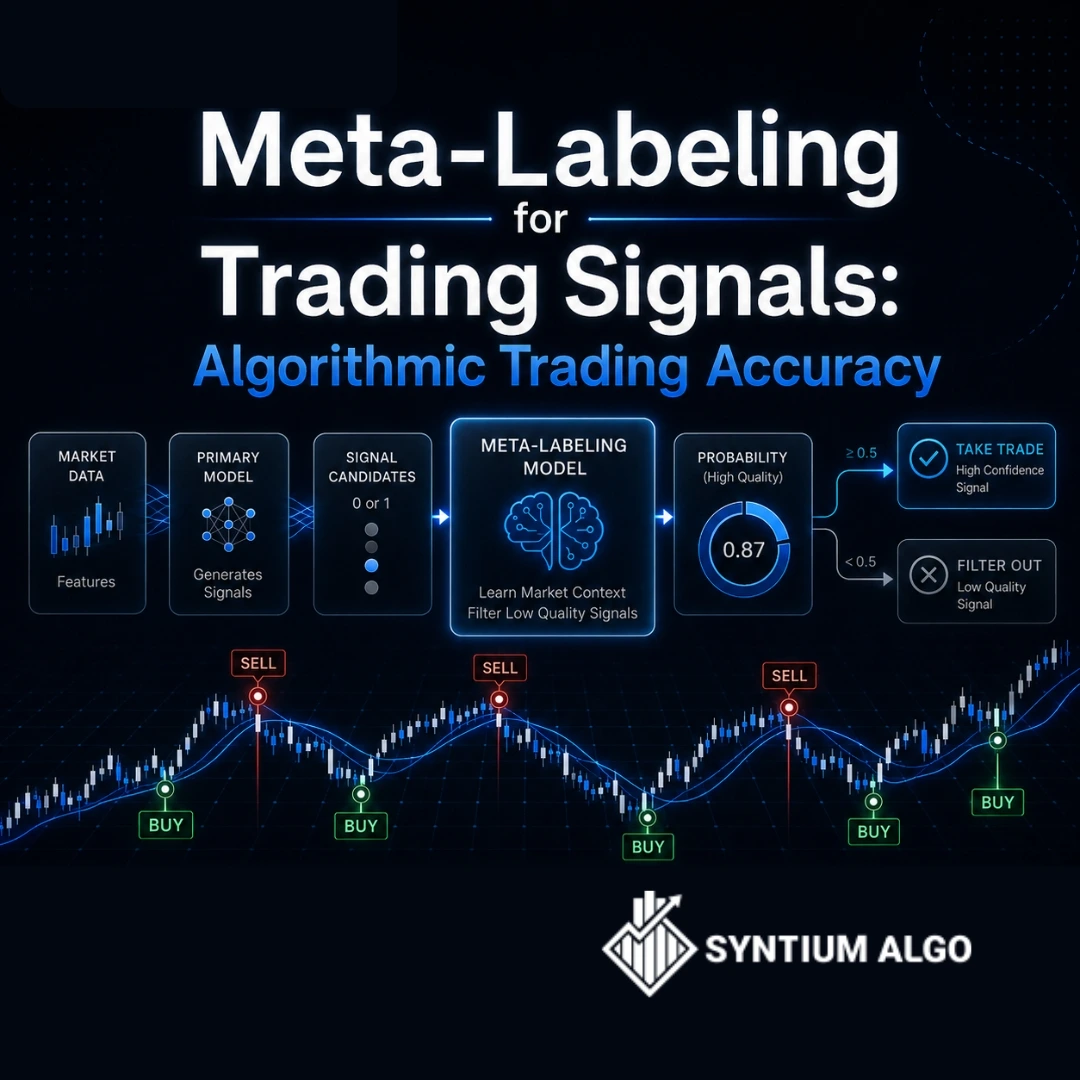
Every algorithmic trader knows the frustrating feeling of watching a backtested strategy fall apart when live money hits the market, which is why applying meta-labeling for trading signals has become an essential framework for modern quantitative developers. You design an indicator that spots trend reversals or breakout setups with high promise, yet unexpected whipsaws constantly trigger stop-losses and eat away at your capital. The core challenge is that primary trading models are built to predict price direction, which leads to high false-positive rates during choppy or volatile conditions. Relying solely on basic buy or sell alerts often forces traders to take low-probability entries that destroy long-term profitability.
Fortunately, implementing meta-labeling for trading signals offers a powerful machine learning framework to filter out bad alerts before placing an order. This advanced technique, uses a secondary machine learning model to evaluate whether a primary signal is worth executing based on broader market dynamics.
Understanding Meta-Labeling for Trading Signals in Quantitative Finance
Traditional quantitative strategies focus heavily on predicting whether prices will move up or down over a given time horizon. While directional prediction is essential, it frequently overlooks whether the expected move is large enough to cover trading costs and slippage. Meta-labeling changes this focus by separating the decision of trade side (buy or sell) from trade execution (take or skip).
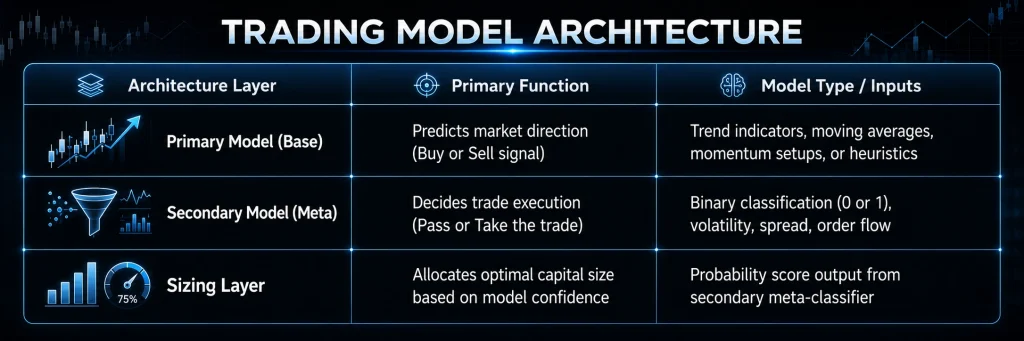
By delegating direction to a primary model and quality filtering to a secondary model, quantitative traders achieve a much higher precision score. The primary model generates raw alerts based on technical indicators or statistical arbitrage, while the secondary model uses market features like volatility, volume, and spread to assess the signal’s probability of success. This two-step architecture drastically reduces false positives while preserving profitable market opportunities.
Primary Signal Generation
The primary model acts as your initial setup engine, identifying structural opportunities in the market. It runs continuously across historical data to flag potential entries based on momentum, mean reversion, or pattern recognition.
Secondary Classification Filter
Once a primary alert triggers, the secondary meta-model steps in to analyze the surrounding context. It looks at background features such as implied volatility, market regime indicators, and liquidity metrics to determine if the trade setup is favorable.
Probability-Based Trade Execution
Instead of executing every primary alert blindly, the system only enters trades where the meta-labeling model outputs a high confidence probability. This selective approach preserves capital and boosts your overall Sharpe ratio.
How Meta-Labeling Improves Algorithmic Risk Management
Risk management is the backbone of long-term trading survival, and filtering out bad trades is far more effective than trying to manage a failing position. Standard risk management techniques rely on fixed stop-losses and take-profit targets, which can get hit prematurely during high-volatility events.
Applying meta-labeling for trading signals gives systematic traders a dynamic tool to adjust exposure before entering a trade. By evaluating the quality of each trade setup beforehand, your system automatically stays on the sidelines during unfavorable market regimes. This structural filter reduces drawdown frequency and keeps your capital safe for high-probability market opportunities.
Here are key benefits of incorporating meta-labeling into your quantitative risk management framework:
- Drastic Reduction in False Positives: Filters out low-quality alerts generated by lagging indicators during market consolidation.
- Improved Sharpe and Sortino Ratios: Eliminates unprofitable trades, which reduces drawdowns and smooths out equity curves.
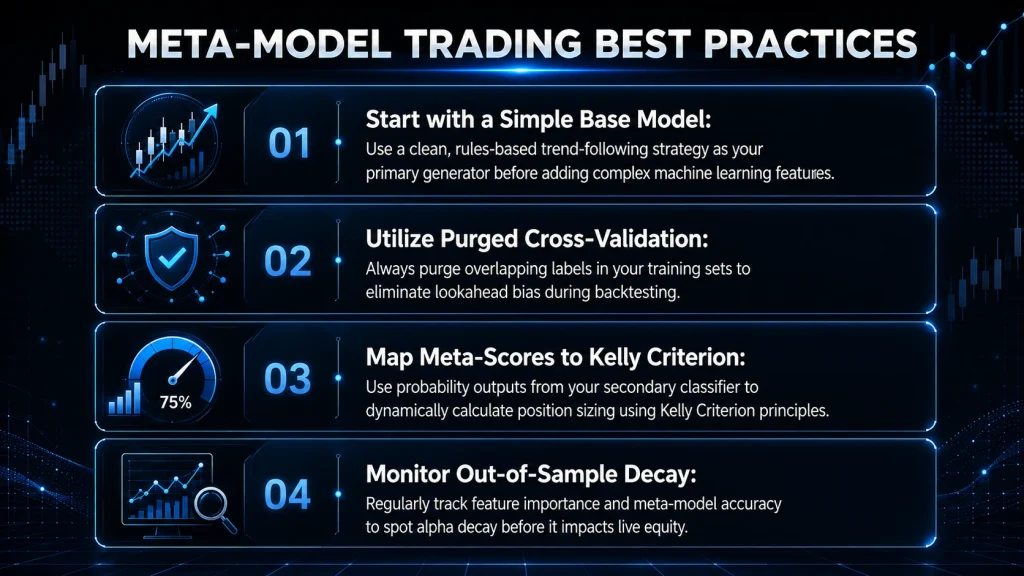
- Dynamic Capital Allocation: Allows automated systems to scale position sizing dynamically based on secondary model confidence.
- Protection Against Regime Shifts: Helps algorithms adapt when market conditions shift from trending to range-bound states.
Reducing Overfitting in Model Training
Training a single machine learning model to predict direction and timing often leads to severe overfitting. Splitting the task into a primary setup finder and a secondary meta-filter allows each model to specialize, creating a more robust framework.
Enhancing Position Sizing Mechanics
Meta-labeling outputs a continuous probability score between 0 and 1 representing confidence in a signal. Traders can map this score directly to position sizing algorithms, placing larger trades when confidence is high and smaller trades when setups are marginal.
Mitigating Market Microstructure Noise
Microstructure factors like bid-ask spreads and order book imbalances frequently cause false breakout signals. The secondary model learns to identify these noisy conditions and holds back trade execution until conditions stabilize.
Step-by-Step Implementation of Meta-Labeling Strategies
Building a meta-labeled trading strategy requires a structured data pipeline and a clear labeling methodology. Quant developers typically use target labeling techniques, such as the triple-barrier method, to define what constitutes a winning or losing trade setup.
Once target labels are defined, you train your base strategy to generate directional calls, and then feed those calls along with contextual features into your secondary classification model. Testing this machine learning architecture across out-of-sample data ensures your filter works across diverse market conditions.
Defining the Triple-Barrier Method
The triple-barrier method sets three distinct boundaries for every signal: a upper profit barrier, a lower stop-loss barrier, and a time barrier. If price hits the profit barrier first, the trade label is marked as 1; if it hits stop-loss or time barriers first, it is marked as 0.
Feature Engineering for the Meta-Model
The secondary filter relies on contextual features rather than simple price history. Inputting volatility indices, order flow imbalances, funding rates, and volume profiles equips the meta-model with rich context for trade assessment.
Training the Secondary Classifier
Popular machine learning algorithms like Random Forests, XGBoost, or LightGBM work exceptionally well as secondary meta-classifiers. These models excel at recognizing non-linear interactions between feature sets to predict signal reliability.
Overcoming Common Pitfalls in Financial Machine Learning
While meta-labeling is a game-changer for quantitative trading, implementing it incorrectly can introduce subtle biases that ruin live performance. Data leakage, serial correlation, and lookahead bias are common traps that destroy machine learning models in financial backtesting.
To build reliable automated systems, quantitative analysts must implement strict cross-validation techniques. Using specialized methods like purged group time-series cross-validation prevents future price information from leaking into training datasets, ensuring your live trading results match your backtested expectations.
Handling Data Leakage and Overlapping Events
Financial time-series data often contains overlapping price bars when evaluating multi-day trade barriers. Purging overlapping samples from training datasets prevents model leakage and ensures realistic cross-validation scores.
Addressing Class Imbalance Challenges
High-quality trading signals occur less frequently than noisy market entries, creating an imbalanced training dataset. Using techniques like synthetic oversampling or class weighting ensures your meta-model learns to recognize winning setups accurately.
Managing Execution Slippage and Transaction Costs
A meta-labeled setup might look profitable on paper, but high transaction costs can still erode gains. Factor real-world exchange fees, spread costs, and expected slippage into your barrier labels to maintain realistic performance expectations.
Practical Steps to Optimize Your Trading Signals Today
Integrating meta-labeling into an existing algorithmic trading pipeline requires systematic refinement. Whether you run python trading bots or develop custom institutional strategies, start by analyzing your base model’s trade logs to identify recurring loss patterns.
By focusing on actionable refinements, you can transform a basic trading algorithm into an institutional-grade quantitative strategy. Start small, validate every feature, and scale up your deployment gradually.
To make an immediate difference in your system’s performance, consider applying these two tips right away:
1: Audit Your False Positive Trade Clusters
Export your strategy’s losing trade logs and categorize them by background market volatility. You will likely find that over 60% of losses occur during low-volatility or narrow-range regimes.
2: Apply a Volatility Filter to Base Signals
Implement an Average True Range (ATR) or volatility threshold as a simple rules-based secondary filter before building a full machine learning meta-labeling model.
Follow these proven implementation guidelines to build robust trading algorithms:
Designing a Clean Feature Store
Organize your market features cleanly so that base signals and contextual metrics update in real-time. A well-structured feature pipeline ensures latency stays minimal during order execution.
Backtesting Under Stress Conditions
Test your meta-labeled system against historical stress events like market crashes or sudden liquidity droughts. Ensuring your secondary filter holds back trades during severe turbulence prevents catastrophic losses.
Scaling Automated Live Deployment
Roll out your updated strategy on paper trading or low-capital live accounts first. Monitoring real-time fill rates and meta-model decisions confirms that your execution engine handles live market microstructures smoothly.
learn more with Syntium algo! sign up now.
FAQs
What is meta-labeling for trading signals?
Meta-labeling is a secondary machine learning model that predicts whether a primary trading signal will be profitable, acting as an intelligent execution filter.
How does meta-labeling improve machine learning accuracy in trading?
It separates directional forecasting from trade execution, allowing base models to focus on setups while the secondary model filters out false positives based on market context.
What is the triple-barrier method in meta-labeling?
The triple-barrier method labels trades based on whether price hits a take-profit level, a stop-loss level, or a time limit first, providing clear targets for model training.