Disclaimer: Syntium Algo and all affiliated parties are not registered as financial advisors. The information provided on this site, along with the products and services offered by Syntium Algo, are intended for educational purposes only and should not be interpreted as financial advice. It is important to understand the risks involved in trading and be willing to accept any level of risk when investing in financial markets. Please note that past performance is not necessarily indicative of future results. Syntium Algo and all individuals associated with the company has no responsibility for your trading results or invest decisions. It is recommended to conduct through research, seek professional advice, and carefully consider your financial situation before making any trading or investment decisions.
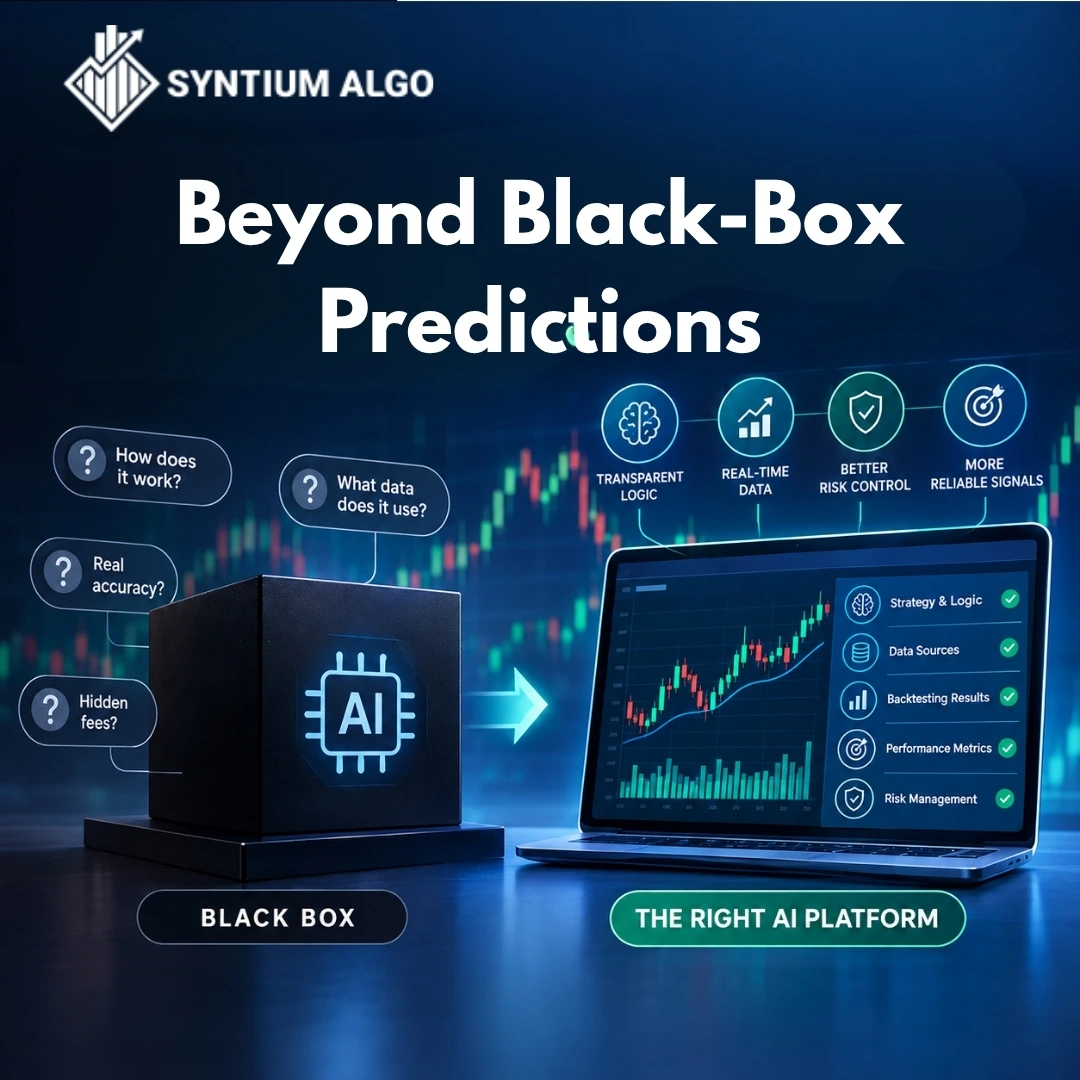
Searching for the best ai platform for trading signals frequently leads traders to opaque “black-box” trading bots promising unrealistically high win rates. You connect your exchange API, launch a automated strategy, and watch it generate profitable trades during trending markets. However, as soon as a market regime shifts or a sudden macroeconomic data release hits the wire, the system collapses. The platform buys into falling knives, ignores liquidity drawdowns, and drains your account balance without providing an explanation. This fundamental flaw exposes why legacy signal providers fail: they offer predictions without context, logic, or verifiable risk parameters.
Modern quantitative finance requires a higher standard of transparency and precision. Traders no longer tolerate mystery algorithms that hide their decision-making process behind closed doors. Instead, top-tier systematic traders prioritize platforms built around Explainable AI (XAI) and advanced statistical verification methods like meta-labeling.
Syntium Algo empowers you to harness this evolution. Deploy our advanced agentic AI platform today to move beyond opaque predictions and master market volatility with intelligent, goal-oriented automation.
The Structural Breakdown of Legacy Black-Box Signal Bots
To choose the best ai platform for trading signals, you must first understand why traditional automated signal services fail in live trading environments. Legacy platforms rely heavily on simplistic supervised machine learning models or single-indicator triggers, such as basic moving average crossovers or static momentum indicators.
While these models look impressive in hindsight, they collapse when exposed to real-world market dynamics.
Primary operational failure points in black-box signal engines include:
- Regime Blindness: Single-model algorithms trained on historical bull runs cannot adapt when volatility spikes or markets enter chop zones.
- Lack of Feature Attribution: Traders receive a simple “BUY” or “SELL” alert without knowing whether the signal was triggered by volume spikes, social sentiment, or a technical anomaly.
- Zero Verification Layer: Legacy bots process primary signals directly into trade execution without testing whether current liquidity conditions support a favorable risk-reward ratio.
- Overfitting & Curve-Fitting: Developers optimize models against historical noise to achieve high backtest win rates, resulting in rapid strategy decay during live market execution.
The Rise of Explainable AI (XAI) in Quantitative Trading
The defining characteristic of the best ai platform for trading signals is complete model interpretability. Explainable Artificial Intelligence (XAI) transforms trading signals from blind predictions into auditable, data-backed market hypotheses.
1. Feature Attribution via SHAP and LIME Values
Explainable AI engines utilize mathematical frameworks like SHAP (SHapley Additive exPlanations) to measure the exact contribution of each input variable. For instance, if an AI platform generates a bullish signal on Bitcoin, XAI shows whether the trade is driven 45% by spot order book imbalances, 35% by macro bond yield shifts, or 20% by momentum indicators.
2. Contextual Confidence Scoring
Rather than issuing binary trade alerts, XAI-native systems calculate dynamic confidence intervals based on current market regimes. If market conditions become highly chaotic or illiquid, the platform lowers its confidence score automatically, warning traders to reduce position sizes or stay on the sidelines.
3. Model Audit Trails
Institutional trading environments require strict compliance and strategy auditing. Explainable AI creates a permanent trail of why every trade was initiated, allowing quantitative teams to debug underperforming strategies and eliminate bad assumptions.
Meta-Labeling: Eliminating False Positives and Optimizing Sizing
Even an advanced signal model will generate false signals during choppy, low-liquidity market regimes. Top quantitative traders overcome this challenge through a secondary machine learning technique called meta-labeling.
Popularized by financial machine learning literature, meta-labeling separates the signal generation process into two distinct layers:
- The Primary Model: Focuses purely on identifying direction (predicting whether price will go UP or DOWN).
- The Secondary Meta-Model: Ignores direction and focuses strictly on binary probability (predicting whether the primary model’s signal will be CORRECT or INCORRECT given current market volatility).
By adding a meta-labeling filter, the best ai platform for trading signals filters out low-probability setups before orders hit the exchange. Additionally, meta-labeling output helps dynamically adjust bet sizing: high-probability signals receive optimal position sizing, while lower-probability setups are scaled down or rejected entirely.
Hard Deterministic Risk Controls: The Non-Negotiable Layer
While Explainable AI and meta-labeling provide signal accuracy, software code must enforce absolute discipline over trade execution. An AI model might generate a high-conviction trade setup, but if market spreads widen unexpectedly or an exchange loses liquidity, executing that trade will result in severe slippage.
The best ai platform for trading signals combines probabilistic AI models with hard, non-negotiable code rules. These deterministic circuit breakers run independently of the AI reasoning layer, ensuring that no trade executes if it violates core safety constraints.
Crucial deterministic safety barriers include:
- Dynamic Volatility Breakers: Automatically pauses automated signal execution when Average True Range (ATR) exceeds historical limits.
- Maximum Daily Drawdown Locks: Hardcoded limits that lock execution engines if portfolio value drops by a pre-set percentage within a 24-hour window.
- Order Book Depth Verification: Checks bid-ask spread width and depth before routing trade payloads to prevent front-running and excessive slippage.
- Multi-Exchange Contingency Routing: Routes trades across centralized and decentralized venues dynamically to secure the best available fill price.
How Syntium Algo Delivers Transparent, Institutional-Grade Signals
Syntium Algo was engineered specifically to bridge the gap between complex quantitative tools and everyday execution. By combining Explainable AI, automated meta-labeling filters, and robust risk infrastructure, Syntium Algo provides a powerful environment for evaluating and acting on market signals.
Rather than offering opaque predictions, Syntium Algo gives quantitative developers and systematic traders complete transparency over their trading logic.
Key advantages of using Syntium Algo for AI-driven trade signals include:
- Transparent Logic Visualization: Access clear feature attribution graphs that detail the underlying data points behind every signal.
- Automated Meta-Labeling Filters: Protect capital with secondary machine learning models designed to filter false breakouts and market noise.
- Institutional Risk Circuit Breakers: Protect your account with hardcoded stop-loss, position size, and drawdown parameters that cannot be overridden by AI prompts.
- Multi-Chain Data Processing: Process structured OHLCV price feeds alongside alternative data sources like on-chain sentiment and social trends in real time.
Step-by-Step Guide: Evaluating AI Signal Platforms
Before connecting your trading account to any automated system, follow this practical evaluation checklist to verify platform transparency and execution quality:
Demand Feature Attribution
Never trade a signal if the platform cannot explain which variables (such as order flow, volume, or sentiment) triggered the alert.
Verify Out-of-Sample Performance
Ensure the platform uses meta-labeling or cross-validation techniques to prevent backtest overfitting on historical data.
Use this step-by-step framework to select the ideal AI trading infrastructure:
- Audit Platform Transparency: Confirm the system offers Explainable AI (XAI) metrics rather than locked black-box predictions.
- Review Risk Filter Architecture: Verify that the platform uses hard deterministic code to enforce stop-loss boundaries and daily loss limits.
- Test Signal Latency and Execution: Run trial strategies in paper-trading environments to evaluate real-time order fill speed and slippage protection.
- Inspect Multi-Data Source Coverage: Ensure the AI ingests structured price data along with on-chain and macroeconomic feeds to navigate regime shifts.
- Start with Scaled Position Sizing: Deploy small allocations initially to observe live meta-labeling filtering accuracy during volatile market sessions.
Upgrade to Transparent, AI-Driven Trading Signals with Syntium Algo Today!
FAQs
What makes the best AI platform for trading signals different from legacy bots?
The best AI platforms use Explainable AI (XAI) to reveal why a trade signal was generated, combined with meta-labeling filters to eliminate false positives, whereas legacy bots rely on opaque, black-box predictions.
How does meta-labeling improve trading signal accuracy?
Meta-labeling uses a secondary machine learning model to evaluate whether a primary trade signal has a high probability of success under current market conditions, filtering out bad setups and optimizing bet sizing.
Can I trust AI trading signals during high market volatility?
You should only trust AI trading signals if they are backed by hard, deterministic risk rules like non-negotiable daily stop-loss limits, spread checks, and volatility circuit breakers that automatically protect your capital.