Disclaimer: Syntium Algo and all affiliated parties are not registered as financial advisors. The information provided on this site, along with the products and services offered by Syntium Algo, are intended for educational purposes only and should not be interpreted as financial advice. It is important to understand the risks involved in trading and be willing to accept any level of risk when investing in financial markets. Please note that past performance is not necessarily indicative of future results. Syntium Algo and all individuals associated with the company has no responsibility for your trading results or invest decisions. It is recommended to conduct through research, seek professional advice, and carefully consider your financial situation before making any trading or investment decisions.
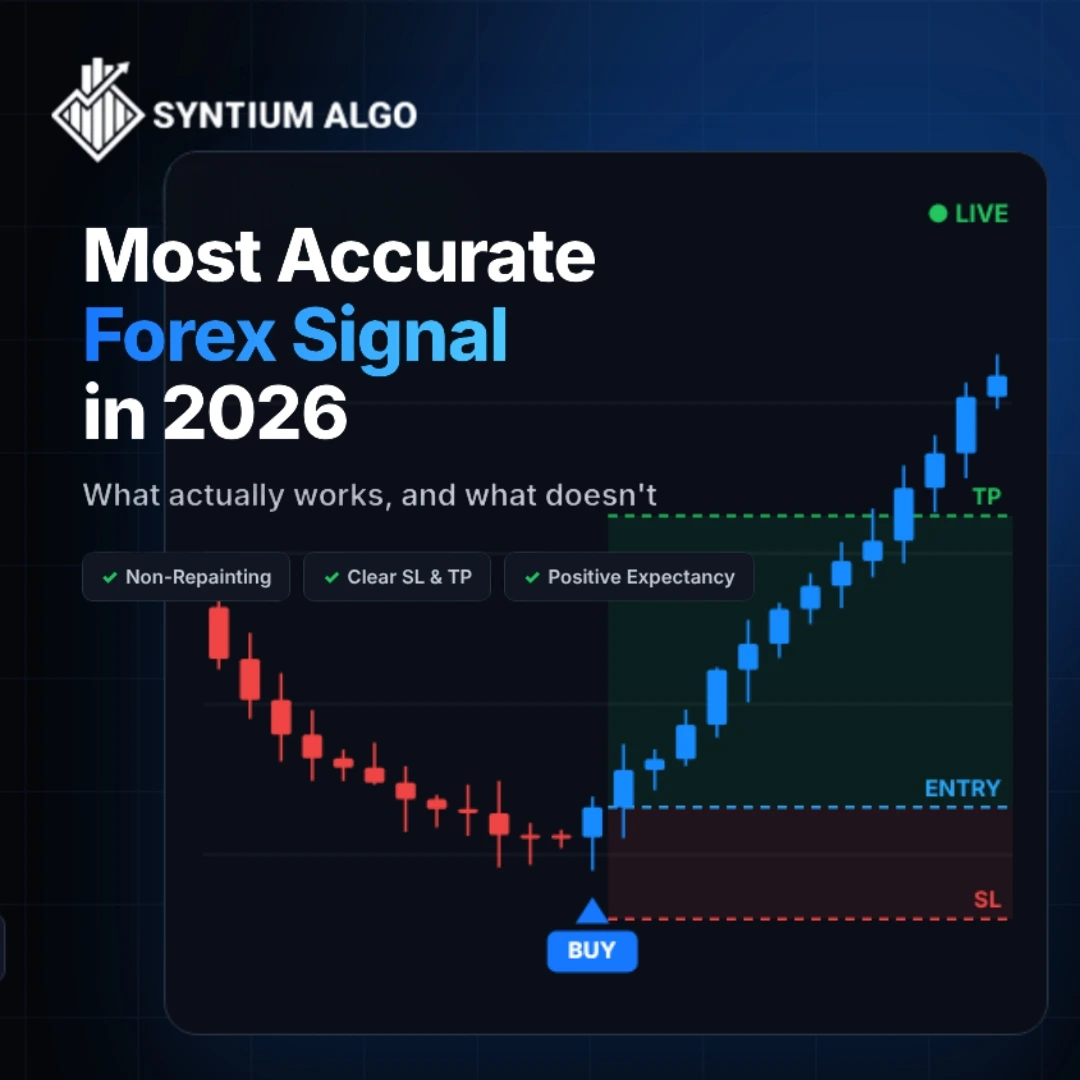
Everyone wants the most accurate forex signal. You see the adverts every day. “95% win rate.” “Never lose a trade.” “Turn £100 into £10,000.” And most of them fall apart the moment real money hits the market.
So what actually works in 2026? Not magic. Not a secret group with a perfect record. What works is a signal built on clear rules, tested over a long period, and paired with proper risk control. This guide shows you how to spot that kind of signal, how to test it yourself, and which warning signs should make you walk away.
Table of Contents
- What “Most Accurate Forex Signal” Really Means
- Why a High Win Rate Can Still Lose You Money
- 7 Traits of an Accurate Forex Signal in 2026
- Forex Signal Types Compared
- How to Test a Forex Signal Before You Trust It
- Red Flags to Watch Out For
- How Syntium Algo Approaches Signal Accuracy
- Risk Management: The Part Nobody Sells
- FAQs
- Final Thoughts
What “Most Accurate Forex Signal” Really Means
A forex signal is a trade idea. It tells you which pair to trade, which direction to take, where to enter, where to put your stop loss and where to take profit.
Accuracy sounds simple. Did the trade win or lose? But that is only half the story. A truly accurate signal does three things well:
- It wins often enough. A steady hit rate over hundreds of trades, not ten lucky ones.
- Its wins are bigger than its losses. The reward per trade justifies the risk.
- It stays consistent. It works across trending, ranging and news-driven markets, or it tells you clearly when to stand aside.
So when you search for the most accurate forex signal, you are really looking for the most reliable one. The one that makes money over time after spreads, slippage and bad weeks.
Quick answer: The most accurate forex signal in 2026 is one with a verified long-term track record, a positive risk to reward ratio, fixed entry and exit rules, and signals that do not repaint or change after the candle closes. Win rate alone does not prove accuracy.
Why a High Win Rate Can Still Lose You Money
This is where most traders get caught. A provider shows a 90% win rate and it looks amazing. Then the account shrinks anyway.
Why? Because the few losing trades are huge. The provider takes small profits quickly and lets losses run. One bad trade wipes out ten good ones.
The number that matters is expectancy. It tells you what you make, on average, per trade.
Expectancy = (Win rate × Average win) minus (Loss rate × Average loss)
Here is how two very different signals compare:
| Signal | Win Rate | Average Win | Average Loss | Expectancy per Trade |
|---|---|---|---|---|
| Signal A | 80% | 10 pips | 50 pips | minus 2 pips |
| Signal B | 45% | 25 pips | 10 pips | plus 5.75 pips |
Signal A wins most of the time and still loses money. Signal B loses more trades than it wins and still comes out ahead. That is the reality of trading. Good signals are judged by expectancy, not by how often they win.
7 Traits of an Accurate Forex Signal in 2026
Markets have changed. Liquidity moves faster, algorithms trade around news in milliseconds, and old single-indicator strategies get chopped up. Here is what separates signals that hold up now.
1. No repainting
Some indicators redraw past signals after price moves. The chart looks perfect in hindsight, but those arrows were never there in real time. An accurate signal fires once the candle closes and stays put. We cover this in detail in our guide to non-repainting signals.
2. Confluence, not one trigger
A single moving average cross is noise. Better signals confirm trend direction, momentum and market structure together. When several factors agree, the odds improve.
3. Multi-timeframe agreement
A buy signal on the 5-minute chart means less if the 4-hour trend points down. Strong signals check the higher timeframe before firing on a lower one.
4. Clear entry, stop loss and take profit
“Buy EUR/USD” is not a signal. It is a guess. Every accurate signal gives you an exact entry zone, a stop loss and at least one profit target. If the stop is missing, so is the accuracy.
5. Session and volatility filters
Signals behave differently in the quiet Asian session compared to the London and New York overlap. Good systems filter out low-volatility hours and high-impact news spikes, where spreads widen and stops get hunted.
6. AI filtering of weak setups
In 2026, the best systems do not just generate signals. They also judge them. Techniques like meta-labelling use machine learning to score each setup and skip the low-quality ones. Fewer trades, but better ones.
7. A transparent, long-term record
Screenshots of winning trades prove nothing. Look for months of results that include the losses, ideally on a live account with a regulated broker.
Forex Signal Types Compared
Not all signals come from the same place. Here is how the main types stack up.
| Signal Type | How It Works | Strengths | Weaknesses |
|---|---|---|---|
| Manual Telegram signals | A trader posts ideas in a group | Human judgement, easy to follow | Delays, emotion, hard to verify results |
| Copy trading | Trades are mirrored from another account | Hands-off | You inherit their risk and mistakes |
| Indicator-based signals | Rules on your chart trigger alerts | Instant, consistent, you see the logic | Quality depends on the indicator |
| AI-filtered signals | Algorithms generate and score setups | No emotion, adapts to conditions, filters weak trades | Needs good data and proper testing |
If you are weighing up hands-off options, our breakdown of the copy trading system explains where it fits and where it falls short.
How to Test a Forex Signal Before You Trust It
Never trust a signal because someone says it works. Test it. Here is a simple process you can follow.
- Check the history. Ask for at least six months of results, including every loss. Gaps in the record are a warning.
- Work out the expectancy. Use the formula above. If it is not positive, stop there.
- Look at the worst run. Find the biggest losing streak and the deepest drawdown. Could you survive it without panicking?
- Demo trade it. Run the signals on a demo account for four to eight weeks. Note every entry and exit.
- Factor in costs. Spreads, commissions and slippage eat into small targets. A scalping signal with 5-pip targets can turn negative fast.
- Go live small. Start with your smallest position size. Scale only after the live results match the demo.
Setting up alerts makes testing far easier because you see every signal the moment it fires. Here is how to set alerts on TradingView step by step.
Red Flags to Watch Out For
- Promises of guaranteed profits or “no losing trades”
- Win rates above 90% with no data on average loss
- Signals with no stop loss
- Only screenshots, never full trade history
- Pressure to deposit with one specific unregulated broker
- Deleted signals after a trade goes wrong
- Upfront “account management” fees where someone else controls your money
Your broker matters as much as your signal. A great trade means nothing if your broker is unreliable. Stick with one from our list of regulated forex brokers.
How Syntium Algo Approaches Signal Accuracy
We built Syntium Algo around the traits above. Not to promise perfect trades, because nobody can. But to give traders clear, rule-based signals they can test and trust.
Here is what that looks like in practice:
- Non-repainting signals. Once a signal prints, it stays on the chart.
- Works inside TradingView. Our invite-only indicators sit on your own chart, so you see the logic and get instant alerts.
- Multi-market coverage. Forex, indices, stocks, futures, crypto and commodities across all timeframes.
- No coding needed. Run it in automatic or semi-automatic mode.
- Built-in strategy playbooks. Clear setups for trend, reversal and structure trades, explained in our strategy playbooks.
- VIP signal room and Telegram. Extra trade ideas and support from our team, 24/7.
Since 2022, more than 10,000 traders have used Syntium Algo, with our team working from offices in London and Dubai. If you want to see how our trend logic works on a live chart, read our algo trend trading strategy guide.
Plans start at $29.99 a month, and every plan includes all indicators, future updates and VIP access. You can compare options on our pricing page.
Risk Management: The Part Nobody Sells
Here is the honest truth. Even the most accurate forex signal will have losing weeks. What decides whether you grow your account or blow it is how much you risk on each trade.
- Risk 1% to 2% per trade. Ten losses in a row then cost you around 10% to 20%, not your whole account.
- Always use the stop loss. Never move it further away to “give the trade room”.
- Aim for at least 1:2 risk to reward. This lets you stay profitable with a win rate under 50%.
- Limit open trades. Five EUR pairs at once is really one big bet on the euro.
- Keep a trading journal. Record every signal you take and every one you skip.
For a deeper look at position sizing, read our guide on risk management and capital allocation.
FAQs
What is the most accurate forex signal?
There is no single signal that wins every time. The most accurate forex signal is one with a long, verified track record, positive expectancy, clear stop loss and take profit levels, and no repainting. Rule-based and AI-filtered signals tend to be the most consistent.
What is a good win rate for forex signals?
A win rate between 45% and 65% is realistic for a solid signal, as long as the average win is bigger than the average loss. Anything claiming above 90% deserves serious doubt.
Are AI forex signals more accurate?
AI signals can be more consistent because they remove emotion and filter out weak setups. But they are only as good as their data and testing. Always check the live results.
Are free forex signals worth it?
Some free signals are fine for learning. But many free groups exist to push you towards a specific broker. Check the track record and broker regulation before following any of them.
Which forex pairs give the most reliable signals?
Major pairs like EUR/USD, GBP/USD and USD/JPY usually give cleaner signals. They have high liquidity and tight spreads, which means less slippage and fewer false moves.
Can I use Syntium Algo signals on TradingView?
Yes. After you sign up, you add your TradingView username and the indicators appear under your Invite-Only Scripts. Our TradingView setup guide walks you through it.
Final Thoughts
The most accurate forex signal is not the one with the flashiest win rate. It is the one with clear rules, honest results and a positive edge over hundreds of trades. Pair that with tight risk control and you have something that actually works in 2026.
Test before you trust. Start small. And judge every signal by expectancy, not by hype.
Ready to trade with clearer signals?
Get non-repainting indicators, instant TradingView alerts and VIP signal room access.
View Plans Join Free TelegramDisclaimer: This article is for educational purposes only and is not financial advice. Trading forex and other leveraged products carries a high level of risk and may not be suitable for everyone. Past performance does not guarantee future results. Only trade with money you can afford to lose.